
Blacklist File #7: The American Breakfast
How a meat company's PR problem became America's most enduring food ritual.
EXECUTIVE BRIEF
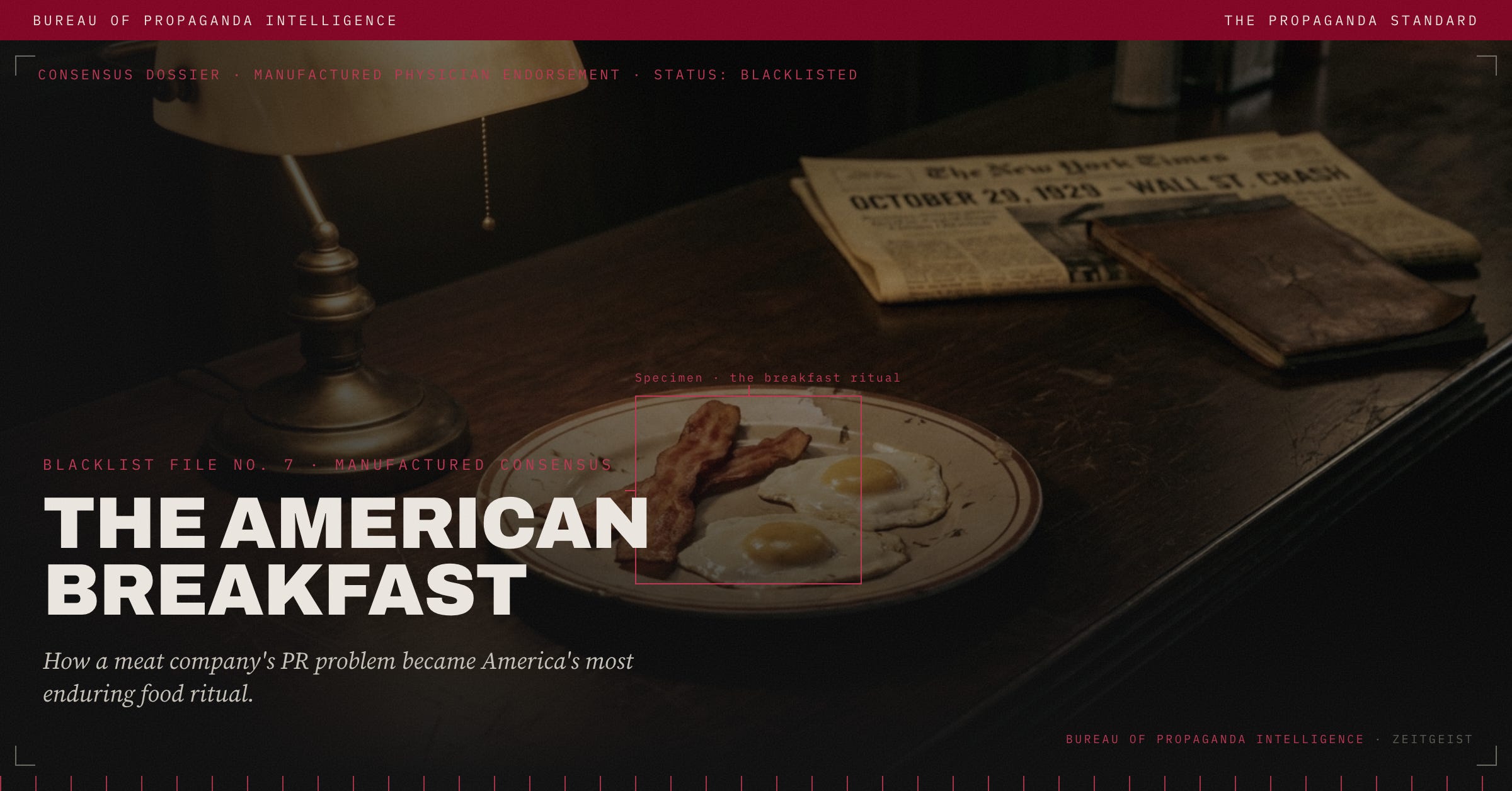
Sometime around 1920–1922, Edward L. Bernays received a brief from the Beech-Nut Packing Company: bacon sales were stagnating. The American breakfast had drifted toward the light and inoffensive (coffee, toast, perhaps orange juice). Beech-Nut needed that table back.
Bernays manufactured a scientific consensus.
He commissioned a physician to survey 5,000 American doctors with a single, clinically honest question: Is a heavier breakfast better for the human body than a light one? Approximately 4,500 answered yes. That finding was released to American newspapers under a headline framing the results as physician urgings toward hearty morning meals. The accompanying press materials helpfully specified what a hearty breakfast looked like. Bacon and eggs, it turned out, fit the bill precisely.
Sales recovered. An eating habit embedded itself into American culture so thoroughly that a century later, Americans eat an estimated 70% of all U.S. bacon at breakfast. Bernays never asked the doctors whether bacon was healthy. He didn’t need to. He asked a better question. One whose honest answer could be weaponized.
THE PROBLEM
By the early 1920s, the American breakfast was in structural decline, at least for Beech-Nut’s revenue line. Industrialization had shifted millions of Americans from physical labor into sedentary office environments, erasing the cultural rationale for high-calorie morning meals. Social aspiration toward thinness, the rising availability of prepared cereals, and Prohibition’s elimination of the whiskey breakfast all pushed habits toward lighter fare. Beech-Nut, which had achieved market dominance through its vacuum-packed sliced bacon innovation (reaching $1M in gross annual revenue by 1905), was facing a plateau with no product-level solution. The problem was the narrative around when and why people ate, and no product feature could address that.
THE OBJECTIVE
Bernays’ mandate was to increase bacon sales without running a conventional product advertisement. The underlying behavior requiring change was breakfast composition. The specific belief requiring engineering: a hearty morning meal is healthier than a light one, and bacon and eggs constitute a hearty morning meal.
NARRATIVE ARCHITECTURE
Narrative Thesis: A substantial breakfast, specifically bacon and eggs, is scientifically endorsed as the healthiest start to the American day.
Narrative Anchor: The physician consensus. 4,500 doctors. A medical survey, released as a news item. The authority belonged to science itself.
Key Messages:
Heavy breakfasts are medically recommended for sustained energy and health
American physicians, in overwhelming consensus, endorse substantive morning nutrition
Bacon and eggs represent the ideal execution of a physician-recommended breakfast
Light breakfasts (toast, coffee) are nutritionally inadequate, a quiet indictment of the existing national habit
Emotional Levers: Health Anxiety / Authority Deference / Status
IMPACT ASSESSMENT
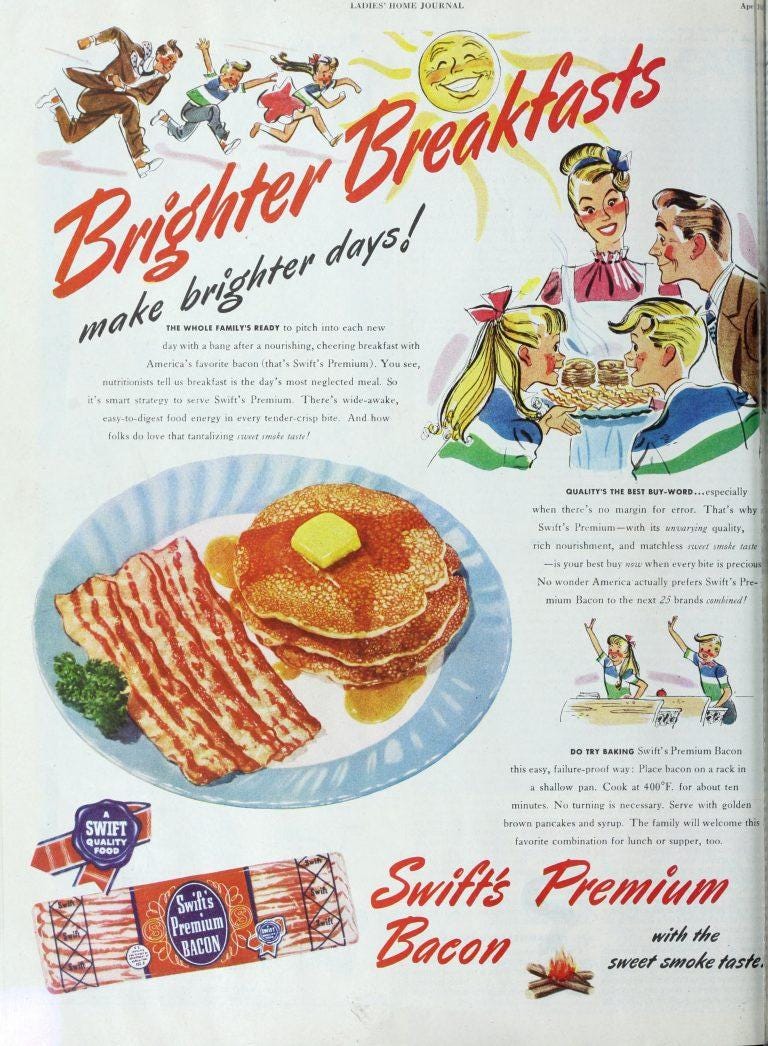
Precise Beech-Nut sales data from the post-campaign period is not publicly available. What is documented is the cultural outcome: bacon sales increased, Beech-Nut’s revenue improved, and Americans now eat an estimated 70% of all U.S. bacon at breakfast. The campaign also established the press-release-as-scientific-study as a repeatable propaganda format, subsequently deployed by the tobacco industry, the sugar industry, and virtually every major food and beverage category that needed to manage public perception. The stated objective was achieved in a form so durable it survived nearly a century without structural revision.
MODERN RELEVANCE
The physician-survey-as-news-item format Bernays pioneered in 1922 is the direct ancestor of today’s “studies show” press releases that cycle through morning news segments. Every supplement company, processed food brand, and pharmaceutical advertiser running “clinically studied” or “physician recommended” claims is operating from his blueprint. The extractable lesson: Authority propaganda works because the question asked shapes the answer received. A carefully designed question produces an honest answer that can be made to serve a purpose the respondents never consented to serve.
This approach is what the Mass Narrative Engineering framework refers to as a “trojan asset.” Here’s how to make one for your business:

ANALYST NOTES
Most people who hear this story focuses on the wrong thing. They marvel at Bernays’ audacity: a PR man who mobilized 4,500 doctors to sell bacon without any of them knowing they were selling bacon. That’s impressive theater. The actual insight is what Bernays understood that most modern marketers still don’t: the most powerful propaganda asks people to act on something they already believe or already want to believe.
American physicians in 1922 genuinely believed heavier breakfasts were more nutritionally substantive than light ones. They weren’t wrong by the standards of their era. Bernays harvested that belief. He routed pre-existing medical consensus through a carefully constructed associative chain and arrived at a conclusion (eat bacon and eggs) that the physicians never endorsed but that flowed from their endorsement as though logically inevitable. That’s narrative architecture. Something far more sophisticated than lying.
The deeper lesson, the one that separates competent from brilliant propaganda operators, is question design. Bernays chose his question carefully. ‘Is bacon healthy?’ would have generated mixed results, controversy, and a story that could be more easily argued against. He asked ‘Is a hearty breakfast better than a light one?’, a question that sounds like breakfast philosophy but functions as a commercial lead.
One degree of separation between the genuine question and the commercial objective. That distance is the engineering. Strip it away and you have an advertisement. Preserve it and you have news. The entire modern PR-to-journalism pipeline runs on this principle, and Bernays built the first section of track in 1922. The train hasn’t stopped since.
MNE Classifications
Type: Campaign
Operator: Edward L. Bernays (commissioned by Beech-Nut Packing Company)
Years Active: 1920–1922
Status: Dormant | Scale: National | Category: Business | Industry: Food & Beverage
Narrative Strategy: Zeitgeist
Ethical Assessment: Indeterminate