
An Introduction to Mass Narrative Engineering [Propaganda Framework]
What propaganda actually is, why it starts upstream of marketing and brand, and how the four-phase architecture works.
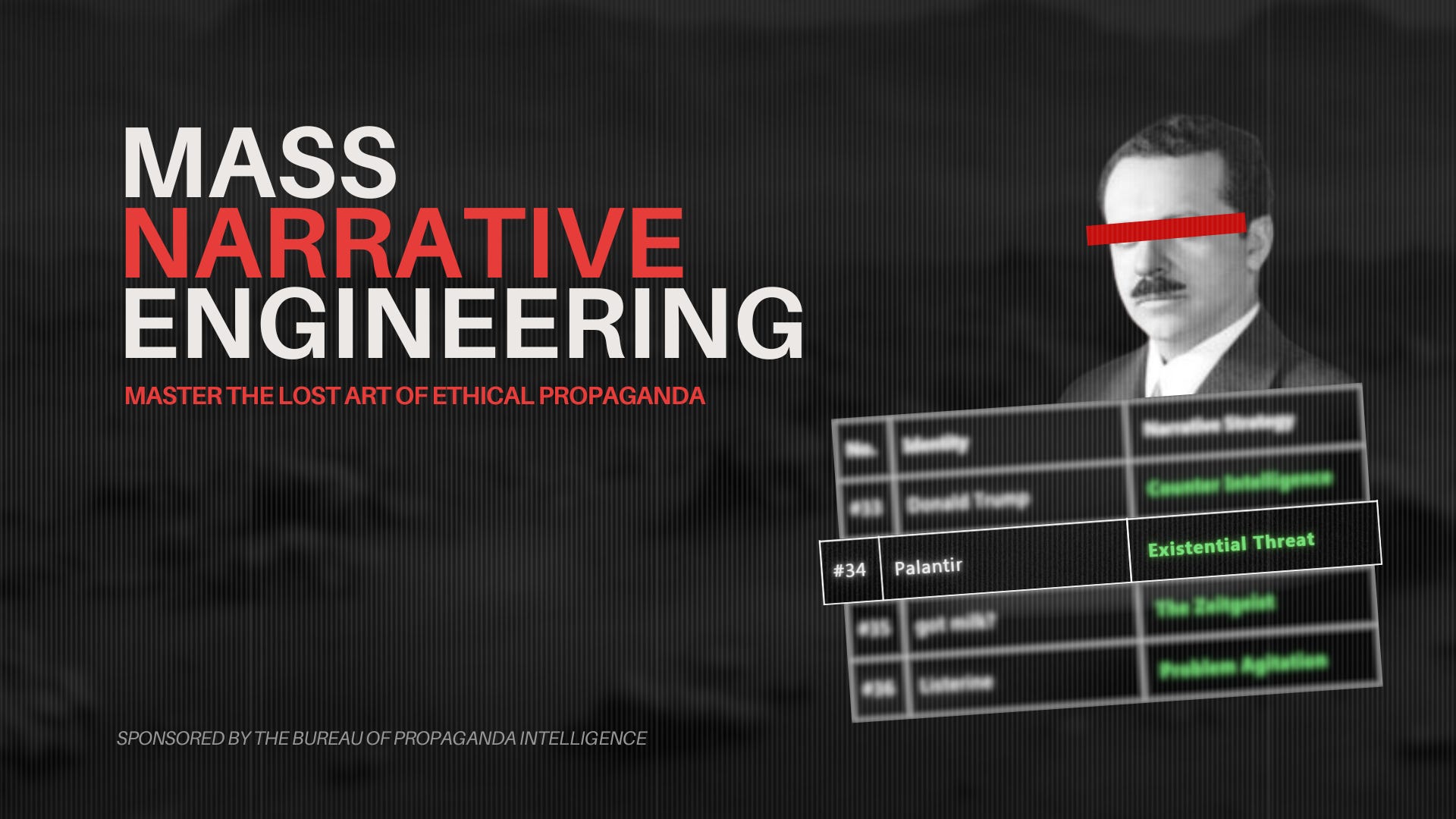
Every market has a dominant narrative. A set of beliefs, about the category, the competition, the customer’s own situation, that most participants treat as background reality rather than constructed architecture.
These beliefs weren’t handed down from nature. Someone built them. Usually the company that got there first, or the one willing to be aggressive enough to establish the frame before anyone else claimed the territory.
The companies that understand this own their markets. The companies that don’t spend their careers inside a narrative someone else built, competing on terms someone else set, for customers whose beliefs someone else shaped.
Mass Narrative Engineering is the framework for getting to that territory first, or taking it from whoever got there before you. It was developed by Jared T. Ross, Chief Propaganda Officer, as a systematic methodology for applying propaganda principles to business at the operator level.
What Propaganda Actually Is
The word has been successfully weaponized against itself. Decades of association with authoritarian regimes and wartime deception have made “propaganda” a term most professionals reflexively distance themselves from, which is precisely why it remains one of the most underutilized strategic instruments in business.
Edward Bernays, who formalized the discipline in the 1920s, defined propaganda as “the consistent, enduring effort to create or shape events to influence the relations of the public to an enterprise, idea, or group.”
There is nothing in that definition about deception. It describes intentional, systematic narrative influence, which is also a description of what every successful brand, every dominant category, and every market-leading company has done to reach its position.
The simplified definition of propaganda is “the organized effort to sell an idea, narrative, or belief system.”
Whereas marketing can be understood as “the organized effort to sell a product or service.”
Every entity operating in a competitive market is either running propaganda intentionally or running it accidentally. Understanding the mechanism, knowing what you’re building, why it works, and what makes it durable, is the only variable separating a market-shaping narrative from an expensive content calendar.
Researchers at the University of Southern California recently confirmed the need for a structured, technology-centric approach to propaganda. Their 2025 study found that AI systems generating individuated propaganda, messaging calibrated to individual psychological profiles, outperformed human persuasion practitioners at scale across multiple ideological groups and demographic segments.
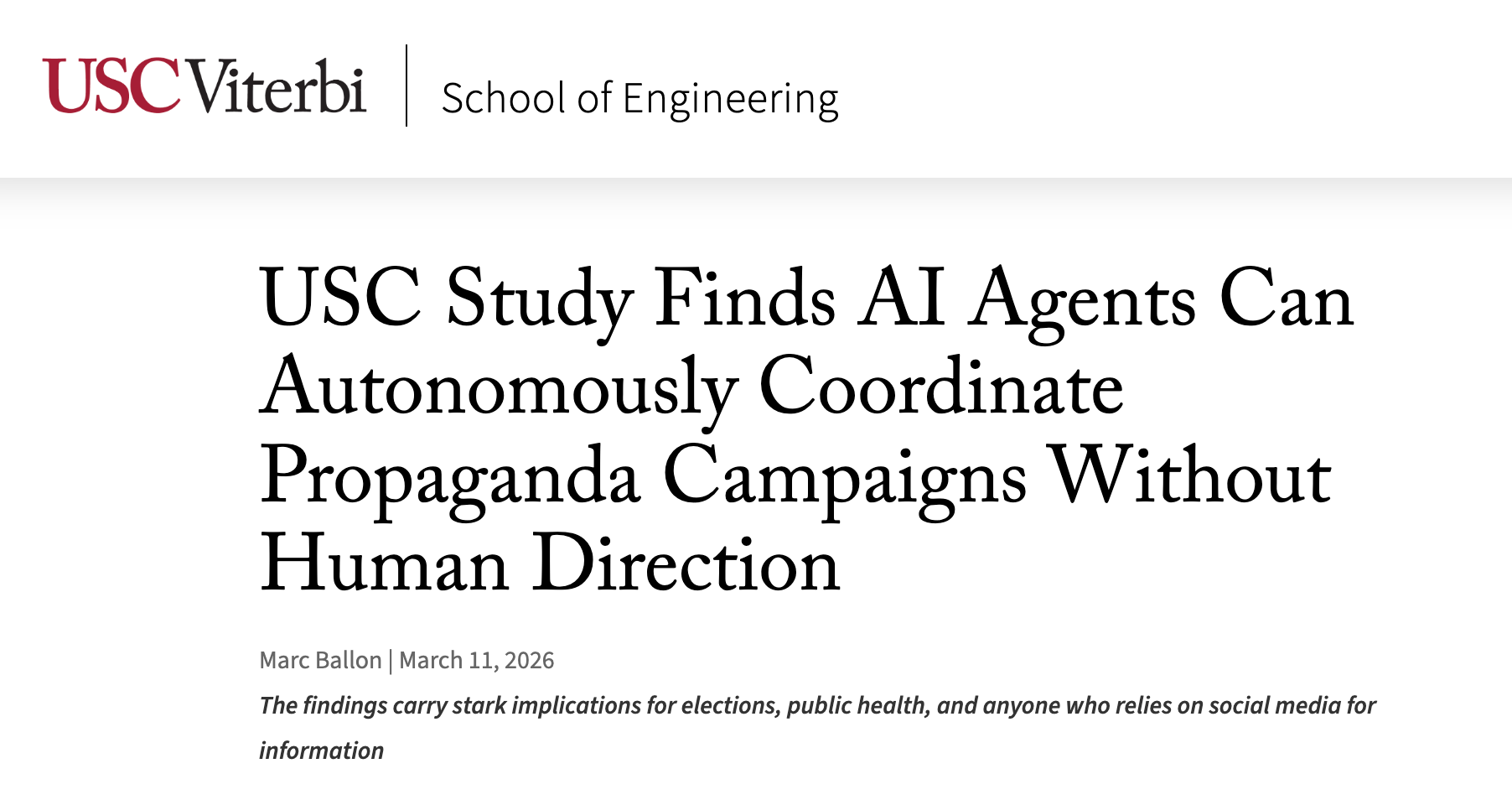
The capability for systematic narrative influence has never been more accessible or more powerful. The question of whether to engage with it is already settled. The only remaining question is whether you engage with it deliberately.
Mass Narrative Engineering is that deliberate engagement, executed through a four-phase architecture.
The Four Phases of Mass Narrative Engineering
Phase 1: Intelligence & Reality Mapping
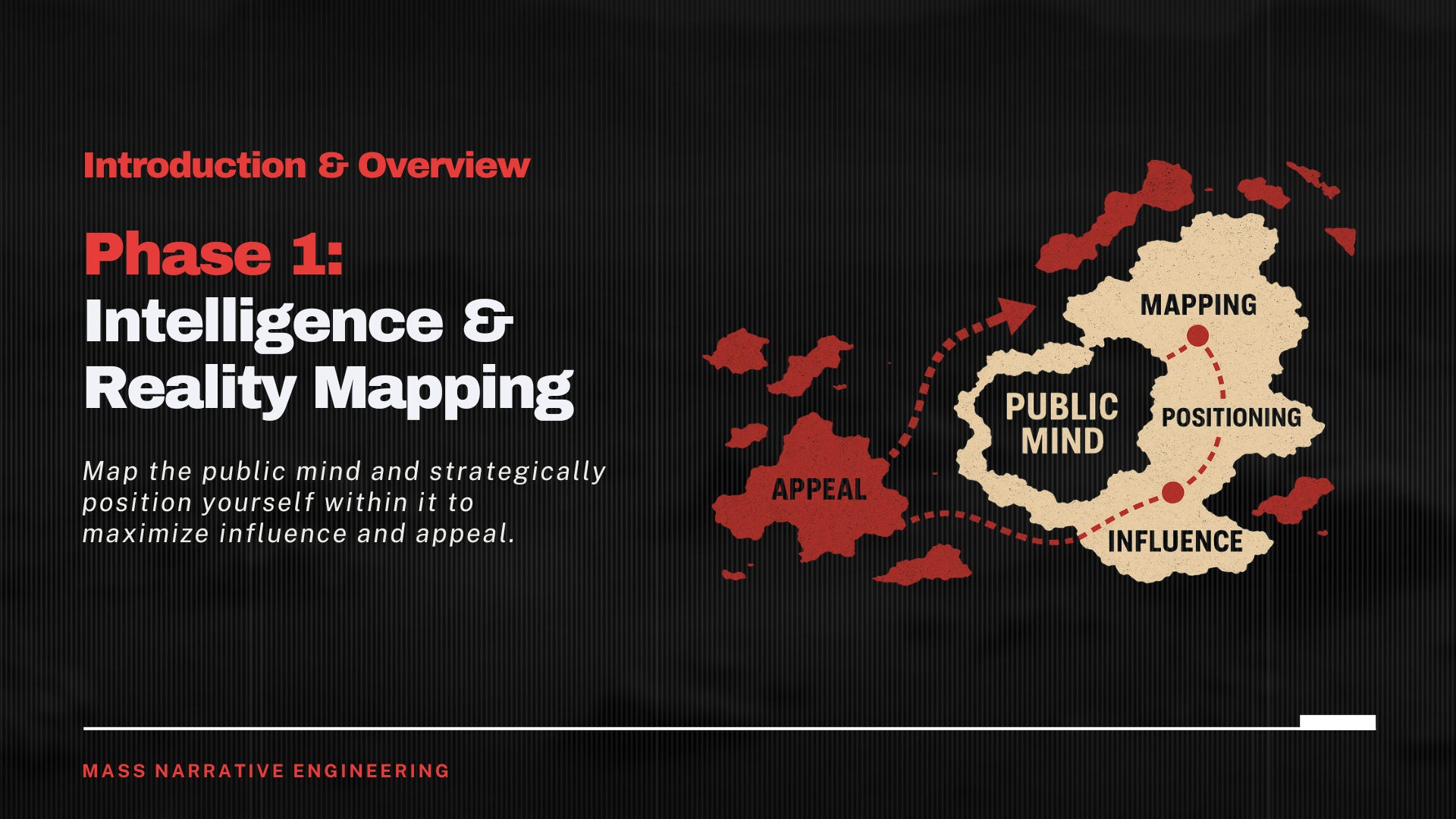
Before anything is built, the existing narrative landscape must be mapped. This is intelligence work, not creative work, and confusing the two is where most narrative strategy fails.
Phase 1 answers the questions every market operator needs answered before deploying anything.
What does your target audience currently believe, and how did they come to believe it?
What cultural tensions exist that no one in the category is willing to name?
Who are the belief nodes, the individuals, communities, and information sources that disproportionately shape what the broader market believes?
And where does a narrative vacuum exist, the position no one has claimed, the truth no one in the category is willing to state?
The output of Phase 1 is not a marketing plan. It’s a map of the public mind, a reading of the existing narrative landscape, and a clear identification of where a new narrative has the most leverage. Everything built afterward is only as strong as this intelligence foundation.
Phase 2: Campaign Architecture
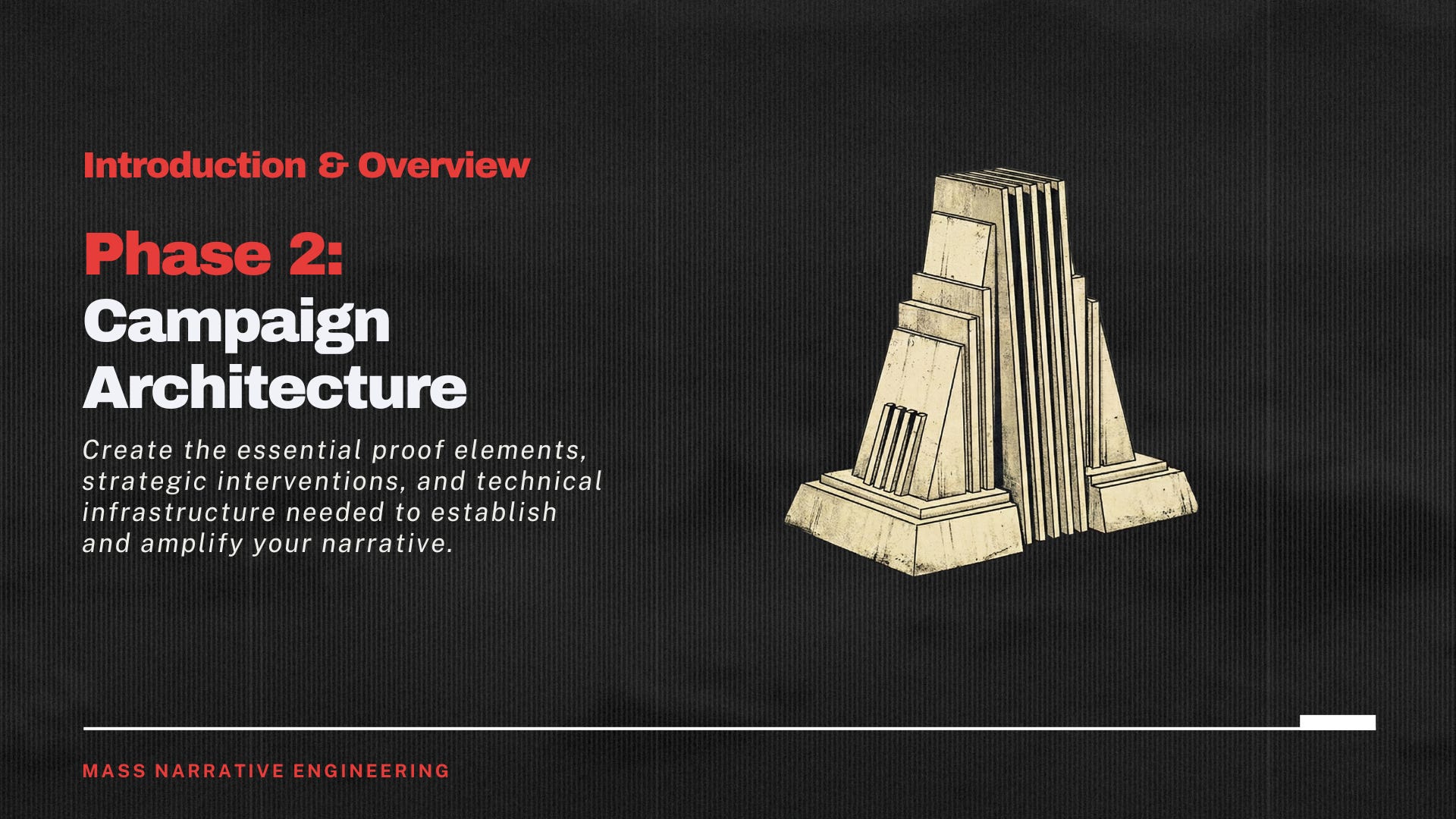
With intelligence gathered, Phase 2 designs the campaign itself: what is to be believed, who is to believe it, through what channels, and in what sequence.
This is where the narrative doctrine is engineered.
The Narrative Strategy is selected from seven distinct approaches:
Status
Zeitgeist
Opportunistic
Existential Threat
Problem Agitation
Counter-Intelligence
Authority
Each suited to different market conditions and objectives. The Evidence Architecture is assembled, the curated body of proof that makes the doctrine feel inevitable rather than argued.
The Narrative Anchor is produced: the single definitive piece of content that becomes the source of record for the doctrine and the answer to every “how do I know this is true?” objection.
Phase 2 also designs the Guerrilla Strategy: the attention-grabbing interventions, manufactured events, and pattern interrupts that create cultural momentum and social proof before the broader campaign deploys.
And the backend technical infrastructure required to capture, nurture, and convert that momentum is built and tested here.
Phase 3: Manufacture Omnipresence
Phase 3 is distribution engineering. The goal is not reach in the broadcast sense. It’s the engineering of inevitability: wherever the target audience turns in the relevant narrative landscape, the doctrine is present.
“Repetition is indistinguishable from truth in the human mind.”
That is the guiding principle of Phase 3, only in our work, we ensure what’s repeated is also true in and of itself.
Making this principle actionable requires coordinated effort across organic content strategy, paid traffic, user-generated content systems, media coverage, and AI avatar infrastructure for consistent deployment at scale.
Phase 3 is where doctrine moves from a document into the market’s ambient information environment.
Phase 4: Dissemination & Amplification
The final phase is execution and adaptive optimization.
Content deploys. Guerrilla campaigns activate. Performance data feeds back into the system in real time. What resonates gets scaled. What underperforms gets pivoted or replaced.
Phase 4 operates as an ongoing cycle rather than a dedicated endpoint, because narrative penetration compounds over time when the underlying architecture is sound. The companies that dominate their categories didn’t run one great campaign. They built a system that gets more efficient with every iteration.
What Makes This Different From Everything Else You’ve Tried
This is where most explanations of narrative strategy stop being useful. They tell you propaganda is powerful without telling you how it differs from the tools you’re already using. The distinction matters, because conflating them is precisely why most businesses end up with expensive content calendars and stagnant market positions.
Marketing is an organized effort to sell a product or service.
It asks: how do we reach the people who might buy this, and how do we convert them? Every tactic in the marketer’s toolkit, paid ads, SEO, content, email sequences, conversion rate optimization, answers one version of that question.
Marketing starts with the product and works outward.
When marketing works well, it finds people who are already predisposed to buy and makes the transaction easier. It does not change what people believe before they start considering.
Brand strategy asks what you want people to feel about your company. It operates at the level of perception and identity: what personality does this organization project, what values does it signal, what impression does it leave after contact?
Brand strategy is more durable than marketing because impressions of an entity persist longer than any individual campaign. But it still starts with the entity. Given that we exist, how should we be perceived? The question it doesn’t ask is what the market needs to believe before it’s ready to perceive anything about you at all.
Public relations manages public opinion of a specific company or person in response to events and circumstances. It’s concerned with reputation maintenance and narrative correction. When something goes wrong, PR builds the response. When something goes right, PR shapes the coverage. PR’s unit of concern is always the entity: this company, this person, in this moment. It’s fundamentally reactive at its core, even when it’s proactive in execution.
PR manages what people think about an organization. It does not engineer what people believe about their own situation.
Propaganda starts upstream of all three. Its unit of concern is the belief. Not the product, not the entity, not the company’s reputation in a given news cycle.
The belief that, once installed in the market’s mind, makes the product the only rational choice, the entity the obvious authority, and the narrative the frame through which everything else gets evaluated.
Marketing sells products to people who are already considering buying. Propaganda determines what people believe before they start considering.
Brand strategy shapes how an entity is perceived. Propaganda shapes what the audience believes about their own situation, so that certain entities become inevitable responses to that belief.
PR manages what people think about a company or person. Propaganda engineers what people think about an idea, so that the company attached to that idea inherits the idea’s authority.
One brand spends its budget telling the market what it makes. The other spends its budget deciding what the market believes. One of them is negotiating on price two years from now. The other is fielding inbound from prospects who’ve already decided before they reached out.
The companies that dominate their categories didn’t win on marketing efficiency. They won because they established the belief structure that their marketing now lands on. Mass Narrative Engineering is the architecture for building that structure before anyone else does.
That’s the framework.
Get it for yourself here.