
How to Achieve Brand Supremacy Using "Deep Positioning" Propaganda
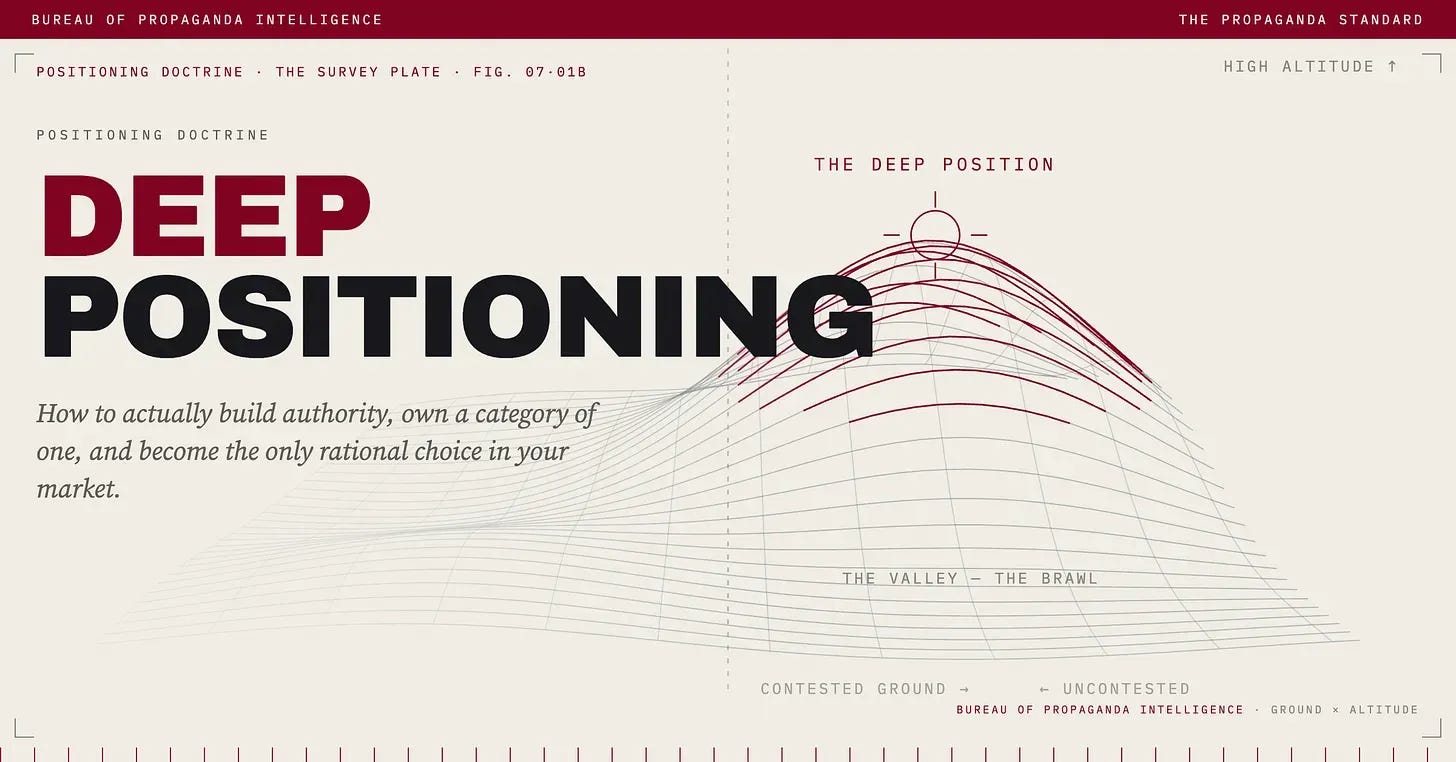
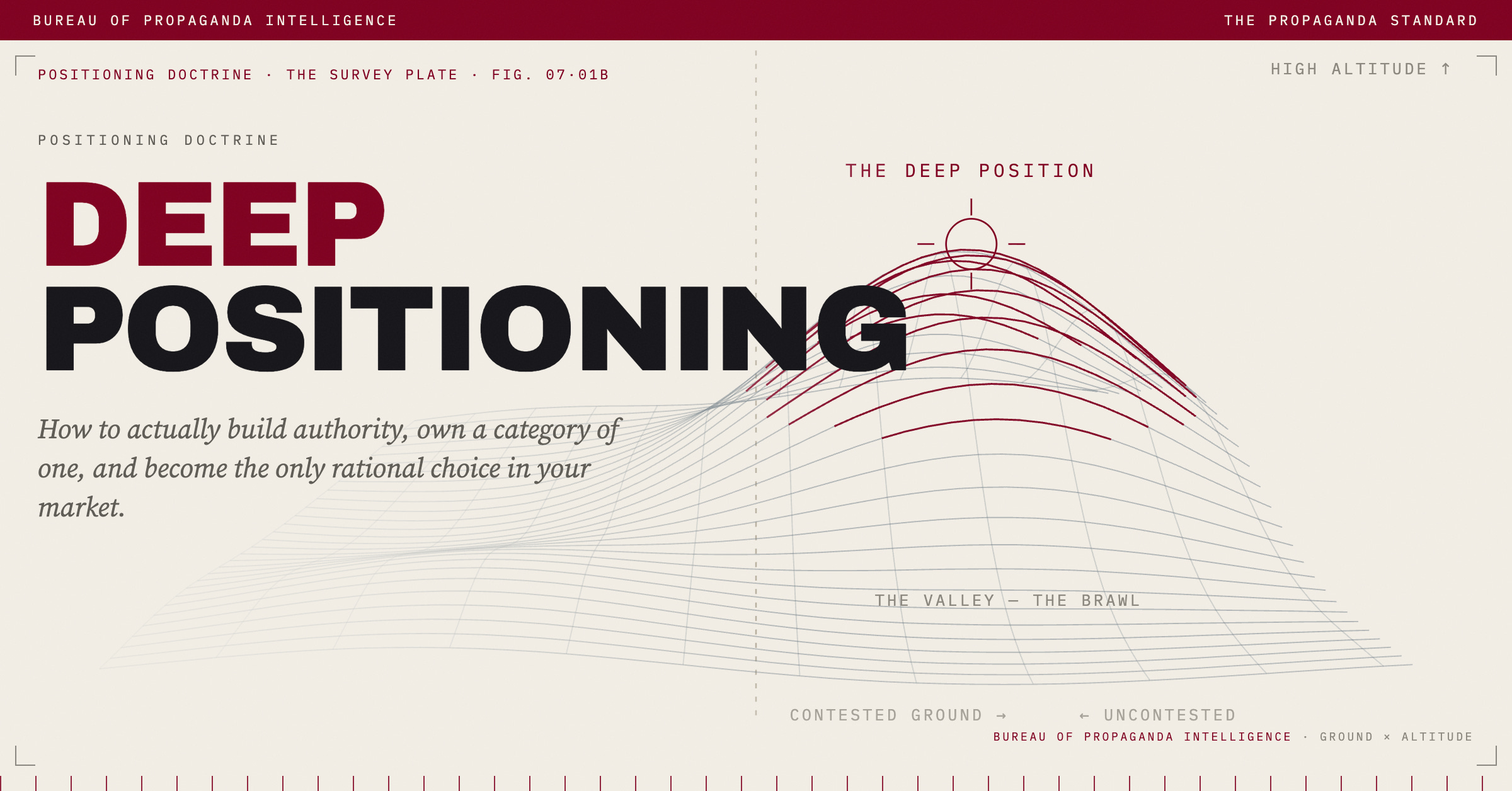
How to actually build authority, own a category of one, and become the only rational choice in your market.
You have the better product. You know it. Your buyers, somehow, do not.
You watch a prospect choose a worse competitor, one with thinner features and a higher price, and you tell yourself the next lead will see it more clearly.
They don't.
So you sharpen the offer, add a feature, cut the price, rewrite the page, and almost nothing changes. You are doing everything the positioning advice told you to do. Find your USP. Niche down. Add more value. Be different. You did all of it, and you are still one more forgettable option on a list, competing on price, explaining why you are worth it to people who already decided you were not.
That advice all operates in the same place, and it is the wrong place.
Tragically, it is rarely the best product or service that wins the market and this single framework explains precisely why none of your efforts have worked long-term.
Every business competes in two markets at once.
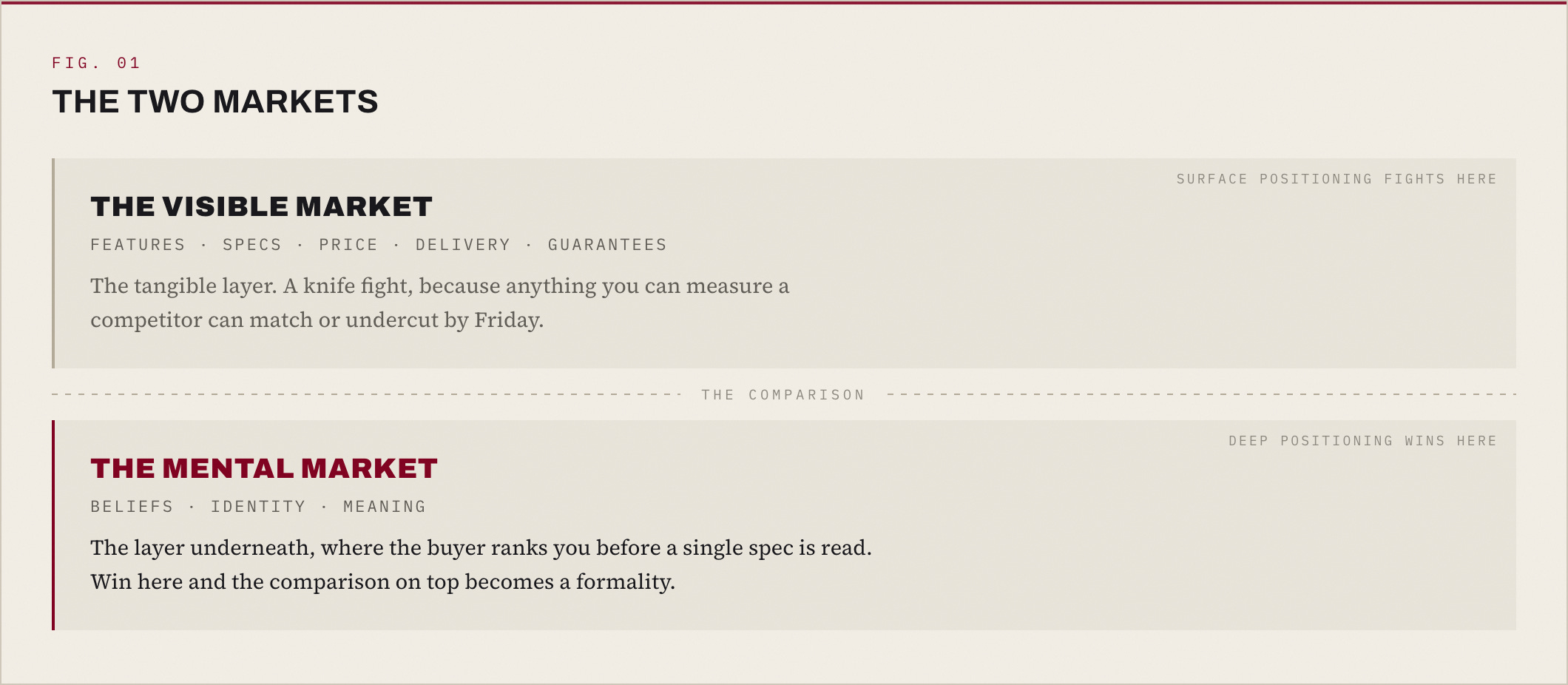
The Visible Market is the tangible one: features, specs, price, delivery, guarantees, the things you can measure and drop into a spreadsheet. It is where almost everyone fights, and it is a knife fight, because anything you can measure, a competitor can match or undercut by Friday.
Underneath it runs the Mental Market: beliefs, identity, meaning. Starbucks sells a version of who you are. Liquid Death sells rebellion against wellness culture. Nike sells the conviction that greatness is already in you. In every case the product is just how you buy in.
Positioning has those same two layers, and almost every founder works only the top one.
Surface positioning competes in the Visible Market. It arranges your features and claims to look like the best option inside a category your buyer already understands.
Deep Positioning works in the Mental Market. It goes underneath the comparison, to the belief that decides which options your buyer takes seriously in the first place.
Surface positioning asks where you fit inside the category. Deep Positioning establishes you as a true novelty and authority while (respectfully) de-positioning your competitors in the eyes of your ideal client.
This matters because of how buying decisions actually happen. Your buyer has already ranked you against your competitors. They did it fast, mostly below conscious thought, before they read a single spec sheet, using beliefs they absorbed long before you entered the picture. When they finally sit down to "compare options," they are not weighing you from zero. They are confirming a ranking their beliefs already handed them. Surface positioning tries to win that visible comparison. Deep Positioning sets the belief that fixes the ranking before the comparison ever starts.
Win underneath, and the comparison on top becomes a formality. The Deep Positioning model is how you do it.
Two Axes: Where You Stand, and Who Vouches for You
A position sits at the intersection of two things. You have to be specific about both, because vague on either one is how strong operators end up nowhere.
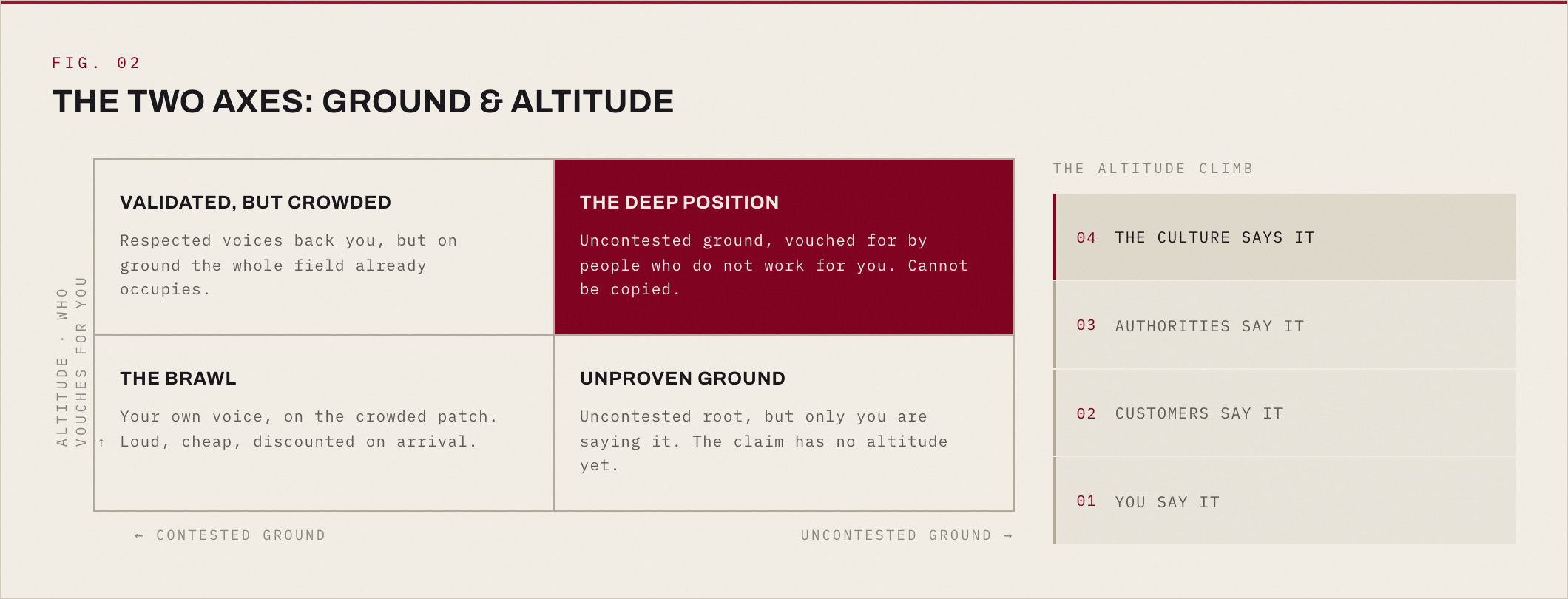
Ground is where you stand in relation to the buyer's real problem. Most of your competitors are crowded onto the same patch of it: they solve a piece of the problem, or they treat the symptom, or they offer a fix that wears off. That is contested ground, and it is loud and cheap. Uncontested ground is the position you find when you dig past all of that to the root of what the buyer actually wants. You win on Ground by moving the fight to the root, where the crowd cannot easily follow.
Altitude is who says your claim is true. At low altitude, you are the one saying it, in your own ad, in your own voice, and buyers discount it accordingly. At high altitude, your customers say it, then respected authorities say it, then the culture says it for you. ClickFunnels never had to argue it was the answer to funnels. The market started saying its name. You gain Altitude by climbing from your own assertions toward validation you did not have to pay for.
The corner you are aiming at is uncontested ground at high altitude: a position no competitor holds, vouched for by people who do not work for you.
The Read: Find the One Belief That Makes You the Obvious Choice
Everything starts with a diagnosis. Before you write a line of copy, you answer one question: what does my buyer have to believe about their problem for me to become the obvious choice?
You find that belief by studying how your market already talks. The words they use for the problem. The complaints they repeat. The workarounds they have settled for. The frustration they feel that nobody in your category is willing to say out loud. Somewhere in there is a belief that, if your buyer fully held it, would leave you as the only option that makes sense.
Then you check one thing, and it decides your entire strategy: does your market already hold that belief, half-hold it, or not hold it yet? Each answer points to one of three moves.
1. Own it, when the belief is already there. Your market already believes it. Your competitors gesture at it weakly or claim it without conviction. You change no one's mind about the problem. You just become the definitive owner of a belief that is sitting in the open, badly served. Volvo never taught anyone to want a safe car. Drivers already wanted that. Volvo simply out-owned the field on safety until the word and the brand became the same thing. This is the cheapest move and, for most businesses, the right one.
2. Carve it, when the belief is half-formed. Your market would agree the instant you said it, but no one has named it yet. You name it, wrap a category around that name, and own the category by being first to make it real. Miller Lite took a fringe idea, lower-calorie beer, gave it the name 'light beer,' and turned it into a mainstream category it owned. Domino's, for years, promised your pizza in thirty minutes or it was free, and built an empire on a belief about delivery time that no competitor had thought to claim.
3. Redraw it, when the belief does not exist yet. Your market does not hold the belief at all, or the current thinking flatly denies it. You install a new belief and stand up a new category on top of it. Red Bull created the energy drink category out of nothing, then spent decades and a fortune convincing the world such a category should exist. This is the most powerful move on the board and the most expensive, because you personally pay the bill to teach the market a belief it does not have.
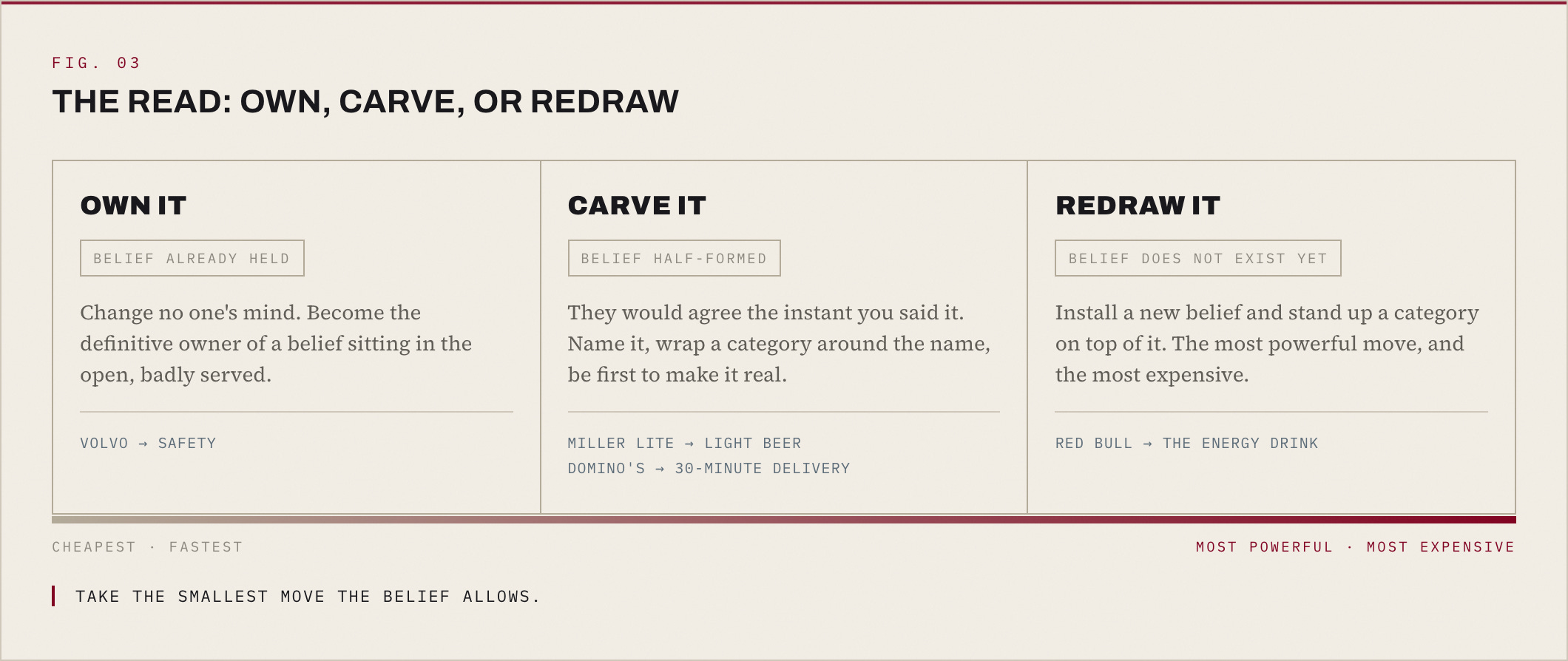
Most founders reach for the Redraw, because inventing a category feels like the impressive play. It is usually the wrong one. Owning a belief your market already holds beats installing a belief they have never heard, at a fraction of the cost and time. Take the smallest move the belief allows. In some instances, you’ll end up using multiple approaches simultaneously.
De-Positioning: The Move That Actually Wins the Sale
This is where most positioning collapses, and it is the part you cannot afford to skip.
Founders differentiate. They say "we're better, we're faster, we're the one built for you." The buyer nods, agrees you sound good, and files you right next to every other option that said the exact same thing. Differentiation explains why you are worth considering. It does nothing about the competitors sitting beside you in the buyer's mind, who are still credible, still familiar, still an easy yes. A field of differentiated equals is still a field of equals.
De-positioning is what breaks the tie. Once you have chosen your move, you de-position your competitors in the mind of your audience. You change how the buyer perceives every other option, so that yours becomes the only one that fully makes sense.
You do it without attacking anyone, and that restraint is the point. You use first principles.
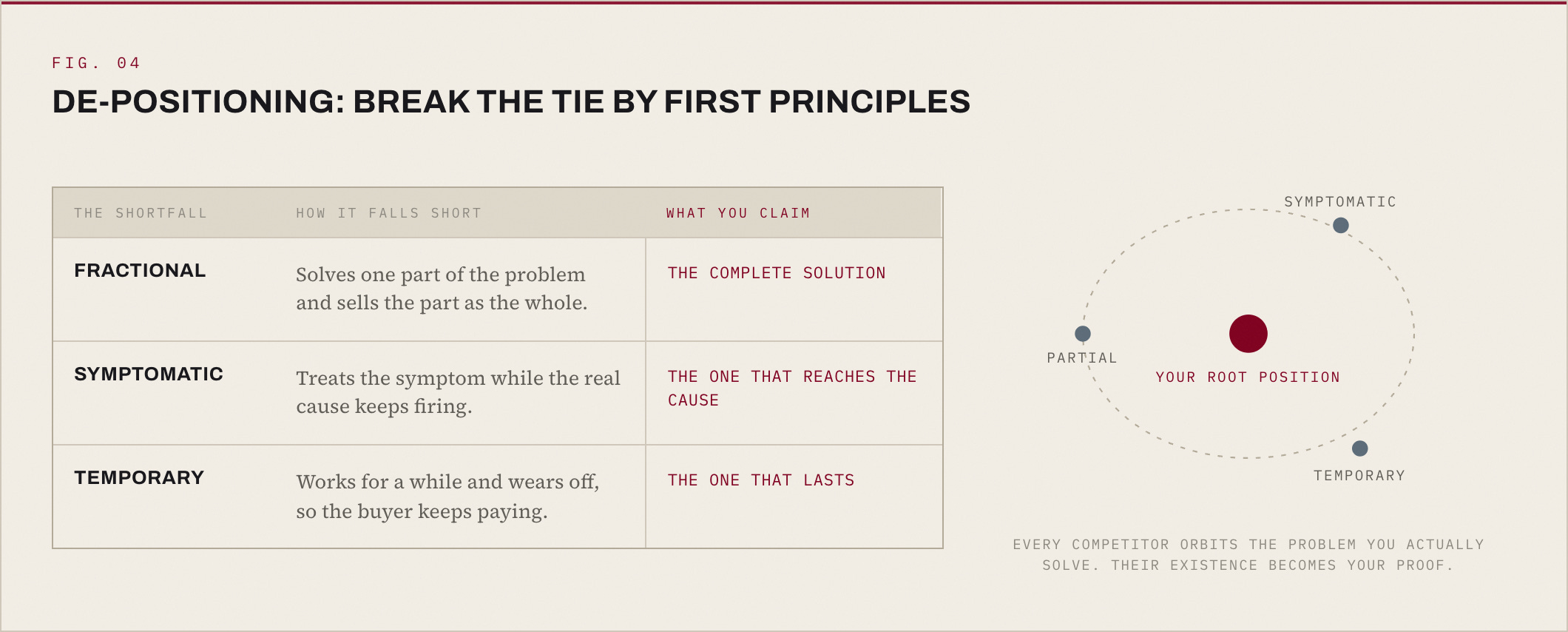
Strip the problem down to its root: what is your buyer actually trying to achieve, underneath the category's usual language? Then hold each competitor up against that root, and watch every one of them fall short in one of three ways.
1. It solves only part of the problem and sells the part as the whole. Call it fractional.
2. It treats the symptom while the real cause keeps firing. Call it symptomatic.
3. It works for a while and wears off, so the buyer keeps paying to fix the same thing. Call it temporary.
You claim the opposite of whichever one applies: the complete solution, the one that reaches the cause, or the one that lasts. And you let the decomposition carry the argument. You never name a competitor or throw a punch. You concede, out loud, what they do well, because conceding their slice is exactly what makes your claim on the whole undeniable. That respect is pure leverage.
Scope did this to Listerine in the 1960s. Listerine was the dominant mouthwash, and it had won on one claim: it killed the germs that cause bad breath. The proof was the taste, a sharp medicinal burn that Listerine’s own advertising embraced, the taste you tolerate twice a day because it means the stuff is working. Scope, a new mouthwash from Procter and Gamble, refused to fight on germ-killing. It made a single move: it sold itself as the mouthwash that fights bad breath and tastes good, minty and pleasant where Listerine was punishing. In one stroke it turned Listerine’s proof of strength, that brutal taste, into evidence of a flaw, and claimed ground Listerine could not step onto without giving up the very harshness that signaled its power.
Salesforce ran the same play on the software industry around 2000. Back then, business software was something you installed: servers to run, an IT team to maintain them, long rollouts, constant upgrades. Salesforce delivered the same tools through a web browser instead, with nothing to install, and built its whole identity around one image, the word “Software” inside a red circle with a line through it: “No Software.” Rather than promise better installed software, it recast the installing itself, the servers and the maintenance every rival treated as normal, as the real problem, and framed every on-premise competitor as the past.
Neither company needed to attack a competitor by name. Each redrew the map so the competition was left standing in the wrong place on it.
Picture your root position as the center of gravity, and every competitor as a satellite orbiting it. Useful. Partial. Dependent on the problem you are the one actually solving. Their existence stops being a threat and becomes your proof: evidence that the problem is real, and that everyone else reaches only part of it.
Do this well and you accomplish what differentiation never can. You become the only option that fully makes sense, without a single bad word about anyone.
The Claim: One Statement That Holds the Whole Position Together
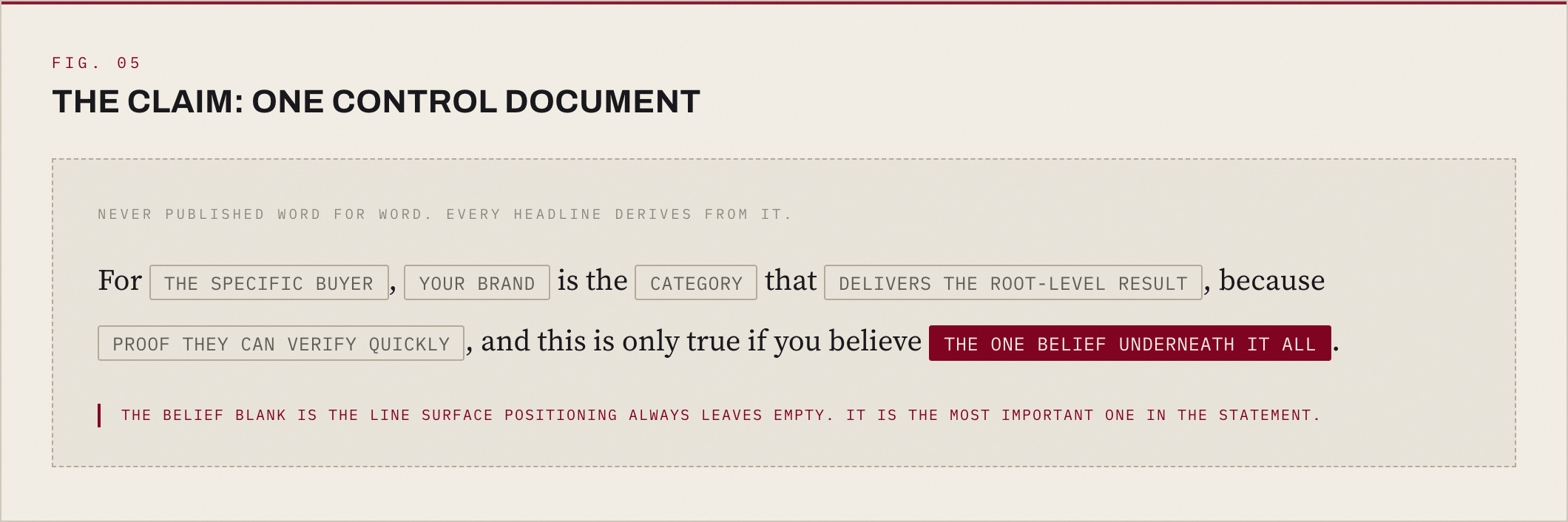
Now you lock it down into a single statement. Think of it as the control document for your entire position. You never publish it word for word. Every headline, every ad, every sales conversation is derived from it. Fill in the blanks:
For [the specific buyer], [your brand] is the [category] that [delivers the root-level result], because [proof they can verify quickly], and this is only true if you believe [the one belief underneath it all].
That final blank is the line surface positioning always leaves empty, and it is the most important one in the statement. Every position rests on a belief. Name yours, and every message you put out traces back to the same foundation. Leave it empty, and your messaging floats on a benefit with nothing holding it up, ready to fall the moment a competitor leans on it.
Here it is filled in, three ways.
A fractional CFO service.
For DTC founders past their first million who cannot tell which decisions actually move the profit line, [Firm] is the profit-decision CFO that turns your numbers into your next move on pricing and inventory, because clean books only show you what already happened and the money is made in the decision that comes next, and this is only true if you believe the real work starts after the books are clean.
A metabolic health coach.
For executives over forty who have lost the same twenty pounds five times, [Coach] is the metabolic rebuild program that changes how your body burns fuel, because a diet runs a month while your metabolism runs the next decade, and this is only true if you believe your metabolism is the real lever and every diet you tried left it untouched.
A B2B support platform.
For Series A SaaS teams buried in support tickets, [Product] is the customer-intelligence layer that turns every ticket into a product decision, because a faster help desk clears today's queue while the same complaints refill it tomorrow, and this is only true if you believe your support volume is a product signal you have been throwing away.
Read the belief line in each one again and watch what it does. It resets the buyer's whole understanding of the problem, and the moment they accept it, the competition is already de-positioned. The bookkeeper, the diet, the help desk. Each one is now visibly solving the wrong thing.
Why the Deep Position Cannot Be Easily Copied
A surface position can always be matched. Claim faster, and a competitor claims faster still. Cut your price, and someone cuts deeper. The Visible Market has no floor, and the race to the bottom always has room for one more runner.
The deep position works differently. It stands on ground a competitor can reach only by publicly agreeing with a belief they have spent years denying, and it is held up by voices they cannot buy. To copy you, they would have to stand in front of their own market and admit you were right about the problem the whole time. Most of them would rather lose the customer than say that out loud. So they stay on the surface, fighting on features and price, inside the belief you installed, on the terms you set, competing for a ranking you already won.
Win the market's mind before it compares you, and the comparison stops being where the sale is decided. It becomes the moment your buyer confirms a decision you made for them, one belief earlier.
Deep Positioning is the positioning discipline inside the broader practice of narrative engineering and propaganda. If you want your own position read, de-positioned against your competitors, and rebuilt at the belief layer, request a propaganda positioning audit at propagandaservices.com. And if this is the clearest account of positioning you have read, subscribe. There is more coming.
Jared T. Ross
Chief Propaganda Officer
Bureau of Propaganda Intelligence