
Fear as a Service
The Most Profitable Business Model Nobody Talks About
Fear is a product.
Every time the world gets loud (war, recession, market crash, pandemic) there’s a class of people who don’t panic. They don’t flinch. They move. Quietly. Strategically. Profitably.
They don’t need to predict the crisis. They just understand something most people never will: fear changes how populations buy. And that behavioral shift is worth more than whatever caused the panic in the first place.
I call this Fear as a Service. It’s been running longer than the internet, longer than television, longer than most nations. And right now, with a war reshaping the Middle East, oil above $100 a barrel, and market sentiment sitting at extreme fear, it’s operating at full capacity.
On you. On your clients. On the people making decisions about money, attention, and trust in your market.
If you understand how it works, you can see it. If you can see it, you stop reacting to it. And when you stop reacting, you gain an advantage most of your competitors will never have. They’re too busy being afraid.
The Mechanics: How Fear Gets Monetized
Fear doesn’t just change how people feel. It changes how they evaluate, how they decide, and how they spend.
A calm person compares options. A scared person grabs the closest thing that promises safety.
A calm person negotiates. A scared person pays whatever you ask.
A calm person questions the pitch. A scared person doesn’t have time to question anything. The threat is too close.
This is the behavioral foundation of Fear as a Service: when populations are afraid, their decision-making apparatus degrades in specific, predictable ways. Evaluation windows shrink. Risk tolerance collapses. The premium on certainty skyrockets. And whoever is positioned as the source of certainty captures the market.
This is historical. And once you see the pattern, you’ll recognize it everywhere.
And just as importantly, know how to take advantage of it (explained below).
Case Study: Y2K and $600 Billion in Fear Revenue
The year 2000 was approaching. Computers might not handle the date change. Systems could crash. Infrastructure might fail.
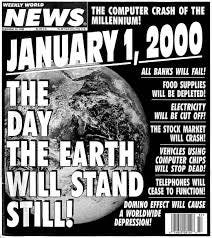
Was the concern legitimate? Partially. Some legacy systems genuinely needed remediation. But the scale of the response had almost nothing to do with the scale of the actual risk. It had everything to do with the scale of the fear.
Technology consulting firms spent two years telling every corporation, government agency, and hospital system on the planet that if they didn’t pay for Y2K remediation, everything would break.
The pitch was elegant in its simplicity: we can’t tell you for certain what will happen, but can you afford to find out?
That question, “can you afford to find out?”, is the atomic unit of Fear as a Service. It makes inaction feel reckless. It makes spending feel responsible. It reframes the purchase from “buying a service” to “avoiding catastrophe.”
Global Y2K spending: estimated at up to $600 billion.
What happened on January 1st, 2000? Almost nothing.
Some of that spending was necessary. A lot of it was not. But the firms that profited didn’t need to prove the apocalypse was real. They just needed to prove it was possible. The fear did the rest.
Case Study: Post-9/11 and Fear as a Permanent Industry
September 11th, 2001 didn’t just change American foreign policy. It created an entirely new economic sector.
Within months, the United States built the Department of Homeland Security, expanded the TSA, deployed color-coded threat level systems across every news network, and opened the floodgates on private defense and surveillance contracts. Billions of dollars in new spending, authorized with almost no public debate, because the fear was too fresh and too sharp for anyone to slow down and ask whether all of it was necessary.
The color-coded threat system is the part most people forget, and it’s the most instructive.
Tom Ridge, the first Secretary of Homeland Security, later acknowledged that he was pressured to raise the threat level for political purposes. The system wasn’t designed to inform the public. It was designed to keep fear ambient. Always present. Never resolved. An orange alert didn’t tell you what to do differently. It told you to stay afraid. And staying afraid meant staying compliant with whatever came next: new agencies, new budgets, new surveillance authorities.
This is the evolution from Y2K. Y2K monetized a single fear event. The post-9/11 apparatus monetized sustained fear. The threat level never went to green. There was never a moment where someone in authority said “it’s safe now.” Because safety wasn’t the product. The perpetual state of not-quite-safe-enough was.
When fear becomes ambient, it stops feeling like fear. It feels like the normal state of reality. And that’s when it becomes most profitable, because people stop questioning the cost of managing it.
Case Study: The Attention Economy and Your Anxiety as Inventory
This one is running on you right now. Probably while you read this.
“If it bleeds, it leads” has always been a revenue model disguised as a cliché about journalism.
Fear generates attention. Attention generates impressions. Impressions generate ad revenue. The entire business model of ad-supported media requires your nervous system to stay activated. A calm audience changes the channel. An anxious audience keeps watching, keeps scrolling, keeps refreshing.
CNN, Fox, MSNBC sell attention, not information. And fear is the cheapest, most reliable mechanism for capturing attention at scale.
Watch how they cover a crisis. Not what they say, but how they structure it. The breaking news chyrons that never turn off. The split-screen panels of people arguing that generate more heat than light. The “stay with us, we’ll have more after the break” loops that train you to not look away. The retired generals brought on as “analysts” who describe threats in language calibrated to keep you uneasy.
Every element is architecture. Designed to sustain attention through anxiety. Your anxiety is the inventory, and their advertisers are paying per unit of it.
Right now, with a war in the Middle East dominating every screen, this system is running at peak capacity. Gas prices, market crashes, missile strikes, oil disruptions. Each headline is a unit of fear, packaged and distributed to an audience that can’t look away. Not because they’re informed by watching. Because their neurology won’t let them stop.
If you understand this, you can choose when to engage and when to look away. Most people don’t have that choice because they don’t see the machinery.
What Fear as a Service Means For You
You’re probably not running a defense contractor or a cable news network. But Fear as a Service runs in your market, too.
In fact, I teach exactly how to use it inside of Mass Narrative Engineering where fear is just one of 7 narrative strategies you can use ethically to generate sales.
Every industry has its version. The cybersecurity company that sells based on breach statistics. The insurance broker who leads with worst-case scenarios. The marketing guru who tells you the algorithm changed and everything you built is now worthless, but here’s a course that will save you.
The question isn’t whether fear-based selling exists in your space. The question is whether you recognize it when it’s aimed at you, and whether you’re equipped to make decisions from clarity rather than reaction.
This is what propaganda literacy actually looks like. Not knowing the word. Knowing the mechanism. Being able to sit inside a fear cycle (market crash, breaking news, industry panic) and ask: who profits from me feeling this way?
That question doesn’t make the fear disappear. It doesn’t make the threat unreal. What it does is restore your ability to evaluate clearly. And clear evaluation is the single most valuable skill in any market, because most of your competitors don’t have it. They’re reacting. You’re reading.
The Deeper Pattern
Fear as a Service works because it exploits a gap between two things: the existence of a threat and the magnitude of the appropriate response.
Real threats exist. Y2K had a kernel of truth. Terrorism is real. Markets do crash. But the profitable move is never in the threat itself. It’s in controlling the narrative around how big the threat is, how urgent the response should be, and who is qualified to provide safety.
That’s propaganda. Not in the colloquial sense, not “lying” or “manipulation.”
In the structural sense: the deliberate engineering of belief at scale to produce a specific behavioral outcome.
Fear as a Service is one application of that structure. There are others. Understanding the structure itself, how belief gets shaped, distributed, and monetized, is the difference between living inside someone else’s narrative and building your own.
That’s what the Mass Narrative Engineering framework was built for. Not to teach people to scare their audience, but to recognize the belief architectures that already surround them, and to engineer their own with intention rather than accident.
What You Can Do About It Right Now
Understanding Fear as a Service is the diagnostic. Seeing the machinery. But seeing it and knowing how to build something better are two different skills.
If this piece shifted how you think about sales, positioning, or narrative control, the next step is learning how to apply propaganda mechanics to your own business without triggering the same resistance patterns you just learned to recognize. I wrote a full breakdown on that called How To Manufacture Trust With Silent Selling + Trojan Assets. It covers format disruption, value-first economics, and the specific mechanisms that eliminate sales resistance instead of trying to overcome it.
Godspeed,
Jared T. Ross
Chief Propaganda Officer
Bureau of Propaganda Intelligence