
How To Manufacture Trust With Silent Selling & Trojan Assets
Why your sales process triggers resistance (and the format disruption that eliminates it)
Trust has collapsed.
Your prospects have seen it all before.
The countdown timer. The “limited spots available.” The discovery call that’s clearly just a sales pitch. The webinar where the stack appears at exactly 45 minutes.
They know the pattern. And the moment they recognize it, they stop listening.
The answer isn’t “better” sales copy or “more persuasive” webinars. The entire framework is broken.
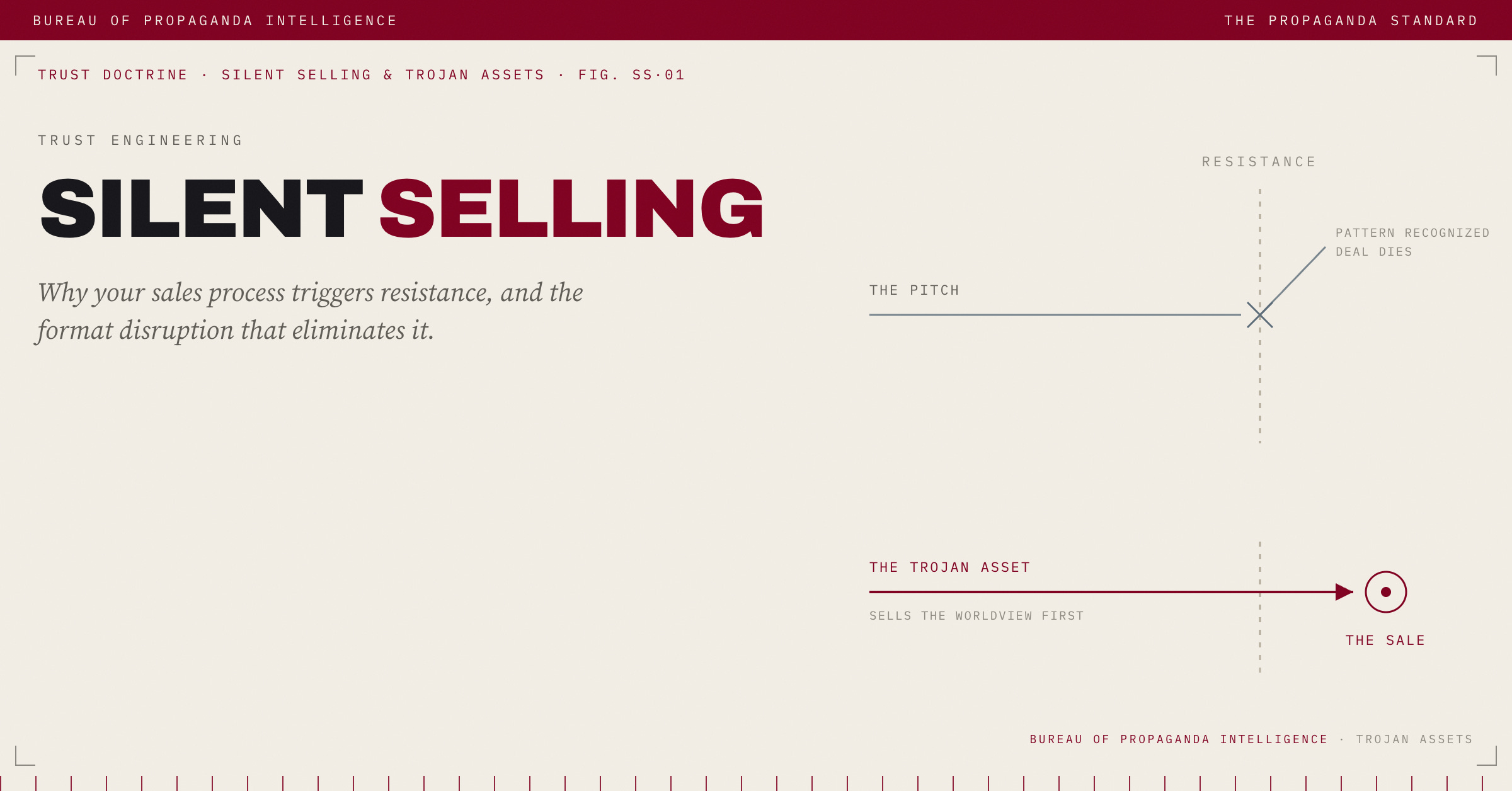
Traditional sales mechanisms trigger pattern recognition, which activates resistance, which kills deals that should have closed.
You’re not losing prospects because your offer isn’t good enough. You’re losing them because they recognize they’re being sold to.
And that’s a propaganda problem, not a marketing problem.
The Problem: Pattern Recognition Kills Trust
The human brain is a pattern-matching machine.
After decades of exposure to the same sales tactics, consumers have developed sophisticated defense mechanisms.
They spot a sales page in milliseconds. They know when the pitch is coming. They recognize the framework.
This pattern recognition triggers immediate psychological responses:
Skepticism increases
Critical evaluation mode activates
Attention shifts to “what’s wrong with this”
Desire to exit or delay grows
Price sensitivity heightens
Every sales tactic that once worked eventually becomes oversaturated and loses effectiveness:
Russell Brunson popularized specific sales page structures. Now everyone uses them, and they all look identical.
Webinars were novel in 2010. By 2025, prospects know exactly when the pitch is coming.
“Free discovery calls” became so common that prospects assume they’re just sales calls in disguise.
When everyone uses the same playbook, the playbook stops working.
The more familiar your sales process, the more resistance it generates.
This is exactly why propaganda exists as a distinct discipline from marketing.
Marketing sells products. Propaganda sells ideas.
The businesses winning right now are indoctrinating their market before they ever attempt a transaction.
Silent Selling is propaganda mechanics applied to your sales process.
Silent Selling: A Different Approach Entirely
Silent Selling operates on a fundamentally different premise:
Don’t try to overcome sales resistance—eliminate the conditions that create it.
You do this by innovating the sales process itself.
The issue isn’t just that traditional sales pages don’t work as well anymore. The issue is that the entire concept of a “sales page” is now a recognized pattern.
It’s why Google Docs are having a major moment in the marketplace right now. You’re seeing them all over the place on X and other platforms.
So you need novel sales mechanisms. New formats that don’t trigger pattern recognition.
Distribution methods prospects haven’t been conditioned to resist.
This is where Trojan Assets come in.
Rather than building better sales pages or more persuasive pitches, you build genuinely valuable assets that prospects actively seek out. The commercial offering is embedded so naturally that buying feels like a logical next step rather than a separate “being sold to” event.
And here’s the propaganda layer that makes this actually work: you’re selling the idea before you sell the product.
Just like Edward Bernays didn’t sell cigarettes—he sold the idea that cigarettes represented freedom.
Just like Apple doesn’t sell computers—they sell the idea that creativity requires different tools.
Your Trojan Asset sells the worldview. The product sale is just the natural conclusion.
The Three Pillars
1. Format Disruption
Break the expected pattern entirely. When prospects encounter a Google Doc instead of a sales page, an AI diagnostic instead of a discovery call, or an audio briefing instead of a webinar, their pattern-matching defense mechanisms don’t activate.
They approach with curiosity rather than skepticism.
This is innovation at the process level. Not better execution of the same tired playbook—entirely new formats that don’t register as “sales mechanisms” yet.
2. Value-First Economics
The asset must provide genuine utility independent of any purchase. If someone uses your asset and never buys, they should still have received meaningful value.
This eliminates guilt, builds trust, and positions you as genuinely helpful rather than transactionally motivated.
But more importantly: this is how you propagate your worldview without triggering resistance. They came for the value. They stay for the indoctrination.
3. Natural Discovery Over Forced Persuasion
Your commercial offering should feel like an optional enhancement, not the point of the interaction.
The prospect should discover your offer as a natural extension of the value you’ve provided, not as the reveal after a persuasion sequence.
When you’ve already sold them on the idea, the product becomes inevitable.
Why This Actually Works
Eliminates Pattern Recognition
Unfamiliar formats don’t trigger learned defense mechanisms. Prospects engage with genuine curiosity.
Reverses The Dynamic
Traditional sales = you chase prospects. Silent Selling = prospects seek you out. The power dynamic completely inverts.
Demonstrates Rather Than Claims
Your asset IS the proof of your expertise. You’re not saying you’re good—you’re showing it.
Sells Ideas Before Products
This is the propaganda advantage. By the time they encounter your commercial offer, they’ve already been indoctrinated into your worldview. The sale is just confirmation.
Self-Qualification
Only serious prospects will engage deeply with your assets. Tire-kickers bounce. Lead quality improves dramatically.
Compounds Over Time
Traditional sales processes are one-time interactions. These assets are permanent and continue working indefinitely.
Builds Genuine Authority
When prospects discover your research archives, diagnostic tools, or comprehensive resources, they perceive you as an authority—not a salesperson.
Trojan Assets: The Implementation Layer
A Trojan Asset is any valuable resource that prospects actively seek out, which contains your commercial offering embedded so naturally that buying feels like progression rather than transaction.
Think of it as a delivery mechanism for both value AND indoctrination.
Characteristics of Effective Trojan Assets
Must Provide Standalone Value
The asset should be genuinely useful even if the prospect never buys anything.
Format Must Align With Positioning
The medium should reinforce your expertise. Selling propaganda research? Archives make sense. Selling automation? AI tools make sense.
Commercial Element Feels Optional
The offer should be presented as an available next step, not the point of the asset.
Propagates Your Worldview
The asset should indoctrinate prospects into your perspective on the problem, the solution, and the market itself. This is Mass Narrative Engineering in practice.
Self-Qualifying
The nature of the asset should filter for your ideal clients naturally.
Shareable
The asset should be worth sharing with others, extending your reach organically.
The Complete Arsenal of Trojan Assets
Document-Based Assets
Living Google Docs
Constantly-updated research documents, industry analysis, or strategic frameworks. Commercial element buried as footnote or side note.
Example: “The Propaganda Playbook” - ongoing research document with occasional mentions of paid program for implementation support.
Apple Notes Link
Raw, unpolished thoughts and observations. Creates authentic feel. Works for real-time analysis or field notes approach.
Example: Real-time campaign observations with natural mentions of how you’d implement similar strategies for clients.
Notion Databases
Comprehensive, organized knowledge bases. Works for complex topics requiring categorization and search.
Example: Complete propaganda case study database with “hire us to implement” as one menu option.
Google Sheets
Calculators, ROI models, planning templates. Highly practical. Works for analytical/financial offers.
Example: “Marketing Budget Optimizer” that naturally surfaces your services when gaps are identified.
Airtable Bases
Shareable databases with filtering and views. Works for resource collections or directories.
Example: “The Propaganda Blacklist” - searchable directory of case studies with consulting services for implementation.
Tool-Based Assets
Custom GPTs
AI assistants that diagnose problems, provide analysis, or teach concepts while naturally surfacing your services.
Example: The “Silent Selling AI Agent” that helps you implement this entire strategy for your business.
Shared AI Chat Threads
Public Claude/ChatGPT conversations showing your thinking process. Commercial offerings mentioned naturally in context.
Example: You working through propaganda strategies with AI, occasionally noting “this is what we cover in Phase 2 of MNE.”
Interactive Calculators
ROI calculators, assessment tools, or planning calculators that reveal opportunities.
Example: “Narrative Vulnerability Calculator” that identifies gaps and positions your services as the solution.
Diagnostic Tools
Assessments or audits that provide value while qualifying prospects.
Example: “Brand Positioning Audit” that scores their current strategy and offers paid help for improvement.
Spreadsheet Templates
Pre-built planning tools or frameworks prospects can copy and use.
Example: “Campaign Planning Template” with embedded video tutorials that mention your done-for-you service.
Audio/Visual Assets
Private Podcast Episodes
Exclusive audio content that teaches while naturally mentioning services.
Example: “Bureau Intelligence Briefings” analyzing current campaigns with occasional mentions of client work.
Audio Sales Letters
10-20 minute teaching sessions that naturally transition to offer.
Example: Deep dive on propaganda principle that concludes with “for implementation, here’s how it works.”
Video Case Studies
Detailed breakdowns of campaigns or strategies with services mentioned as natural extension.
Example: “How We Engineered Market Demand for [Client]” that ends with program information.
Loom Walkthroughs
Screen recordings explaining concepts or reviewing examples.
Example: Analyzing someone’s marketing with suggestions, ending with “want me to build this for you?”
Video Theses or Documentaries
High production video assets that sell viewers your viewpoint or an idea that ultimately leads back to your offers.
Example: Propaganda is Real Documentary
Community/Platform Assets
Telegram Channels
Exclusive analysis or commentary with commercial elements in pinned messages.
Example: Join the Propaganda Intelligence Network where I break down live campaigns, share case studies, and discuss novel propaganda strategies with operators actually implementing this work.
Discord Servers
Community spaces where commercial offerings are naturally part of the ecosystem.
Example: Free community with paid “Inner Circle” tier for implementation support.
Substack Publications
Regular written content with commercial elements in specific posts or footers.
Example: Weekly propaganda analysis with occasional deep dives on client work.
GitHub Repositories
Open-source tools, frameworks, or code with commercial services for implementation.
Example: “Marketing Automation Framework” with paid setup/customization services.
Exclusive Access Assets
Password-Protected Documents
Content requiring a qualifying action to access.
Example: Advanced case studies requiring email or DM to receive password, initiating sales conversation.
Dark Web Publications (.onion sites)
Content hosted on Tor network for exclusivity and brand alignment.
Example: Controversial case studies or unfiltered analysis positioned as “too sensitive for public web.”
Google Drive Folders
Archives requiring access requests, providing email and intent data.
Example: Client work folder that requires request, triggering follow-up about their situation.
Time-Limited Access
Content available only during specific windows or to first X people.
Example: “Strategy Vault” that opens monthly for 72 hours, creating urgency without traditional sales pressure.
Application-Only Resources
Valuable content gated behind qualifying questions.
Example: “Advanced Propaganda Research” requiring application explaining use case, filtering for serious prospects.
Archive/Database Assets
Case Study Libraries
Comprehensive collections of examples, strategies, or campaigns.
Example: “The Propaganda Archives” with hundreds of case studies and “hire us” as database section.
Physical Flashdrive
Flashdrive containing the Trojan Asset/Lead Magnet.
Resource Directories
Curated collections of tools, frameworks, or references.
Example: “The Marketer’s Arsenal” with your services listed alongside other resources.
Framework Libraries
Collections of strategic frameworks or methodologies.
Example: “50 Positioning Frameworks” with your consulting services for custom application.
Screenshot/Receipt Archives
Collections of results, campaigns, or evidence.
Example: “The Proof Vault” showing campaign results with services for replication.
Hybrid/Creative Assets
Fake Internal Memos
Styled like leaked company documents analyzing strategies or opportunities.
Example: “Bureau Strategic Memo #47” discussing market opportunity, with services mentioned naturally.
Interview/Research Recruitment
Positioning sales calls as research interviews or case study opportunities.
Example: “Seeking 5 businesses for propaganda case study documentation” with paid option to keep results private.
Pre-Launch Artifacts
“Draft frameworks” or “beta versions” that generate interest before official launch.
Example: Leaked MNE framework elements with waitlist for complete program.
Collaborative Documents
Shared planning docs or strategy sessions positioned as mutual work.
Example: “Let’s map your strategy together” in shared doc that naturally surfaces paid implementation.
Controversy/Position Papers
Strong stance documents that attract ideal clients while repelling others.
Example: “Why Your Marketing is Propaganda (And Why That’s Good)” with program for implementation.
Building Your First Trojan Asset
Step 1: Define Standalone Value
What will make this valuable even if they never buy?
This must be genuine, not performative. If the only value is “it gets them on a call with you,” it’s not a Trojan Asset—it’s just a lead magnet with delusions of grandeur.
Step 2: Identify The Worldview You’re Selling
Before you think about your product, what idea needs to be adopted for your offer to feel inevitable?
This is the propaganda layer. Read the full framework here.
Step 3: Map Natural Commercial Integration
Where does your offer naturally fit as next step?
Don’t force it. Find where it logically belongs.
Step 4: Innovate The Format
Don’t just execute the same sales process better. Create an entirely new mechanism.
The medium is the message. Your format choice should demonstrate your expertise while avoiding pattern recognition.
Step 5: Build With Quality
Half-assed Trojan Assets are worse than traditional sales pages.
Commit to excellence. A mediocre asset damages your authority more than no asset at all.
Step 6: Distribute Strategically
Share where your ideal prospects naturally gather.
Let them discover it. The discovery itself is part of the process.
Need help building your Trojan Asset strategy? I built an AI agent that does exactly this. Tell it about your business and offer, and it’ll help you craft Trojan Assets and a complete Silent Selling strategy. Get access for $25 here.
Common Mistakes (And How to Avoid Them)
Making the Value Conditional
If the asset is only valuable to people who buy, it’s not a Trojan Asset—it’s just a lead magnet. The value must stand alone.
Forcing the Commercial Element
If your offer feels shoehorned in, prospects will sense it and resistance returns. The commercial element should feel inevitable, not inserted.
Skipping The Propaganda Layer
If you’re not selling an idea first, you’re just using a novel format for the same old sales process. The worldview matters more than the product because there is no such thing as a product.
Choosing Format for Novelty
Pick formats that genuinely serve your content and positioning, not just because they’re different. Being contrarian for its own sake is just performance art.
Neglecting Quality
A mediocre Trojan Asset is worse than no Trojan Asset. Quality is non-negotiable.
Over-Complicating
Start with one strong Trojan Asset. Perfect it. Then build more.
The Meta-Layer: This IS Propaganda
Silent Selling is propaganda mechanics applied to commerce.
You’re shaping how prospects perceive your commercial intent by controlling format and context.
Traditional sales says: “Here’s my offer, let me convince you.”
Silent Selling says: “Here’s something valuable. By the way, if you want more, this exists.”
The prospect’s relationship to you, to the information, and to the buying decision is fundamentally different.
But the real power comes from the indoctrination layer. By the time they encounter your offer, they’ve already adopted your worldview. They’ve already been propagandized.
The sale isn’t a separate event—it’s the natural conclusion of accepting your narrative.
This is why Silent Selling is particularly powerful for propaganda practitioners. You’re teaching what you’re simultaneously demonstrating.
This document is a Trojan Asset. You came for insights on Silent Selling. You’re leaving with a perspective on propaganda, narrative control, and commercial architecture.
And if you want the complete framework for applying propaganda to your business, it’s here.
What Happens Next
As consumer sophistication increases and trust continues declining, Silent Selling will shift from optional to necessary.
The brands that win in the next decade will be those that master value-first commerce and continuously innovate their sales processes.
Traditional sales pages, webinars, and discovery calls won’t disappear—but they’ll increasingly become the domain of commoditized offerings and amateur marketers.
Premium positioning will require more innovative approaches.
Godspeed,
Jared T. Ross
Chief Propaganda Officer
Bureau of Propaganda Intelligence
P.S. Join the Propaganda Intelligence Network on Telegram where I break down live campaigns and share novel propaganda strategies with operators actually implementing this work.