
Why Narrative Beats Product: The Visible Market vs. the Mental Market
Why great products lose on price and features, and how the strongest brands escape commoditization by competing in the market of belief, identity, and meaning.
A Casio quartz watch keeps better time than a Patek Philippe. It costs about twenty dollars, and it will not lose a second across your entire life. A mechanical Patek, at a thousand times the price, cannot honestly make that claim. By the one measurement a watch is supposedly for, the cheap plastic one wins, and it's not even close.
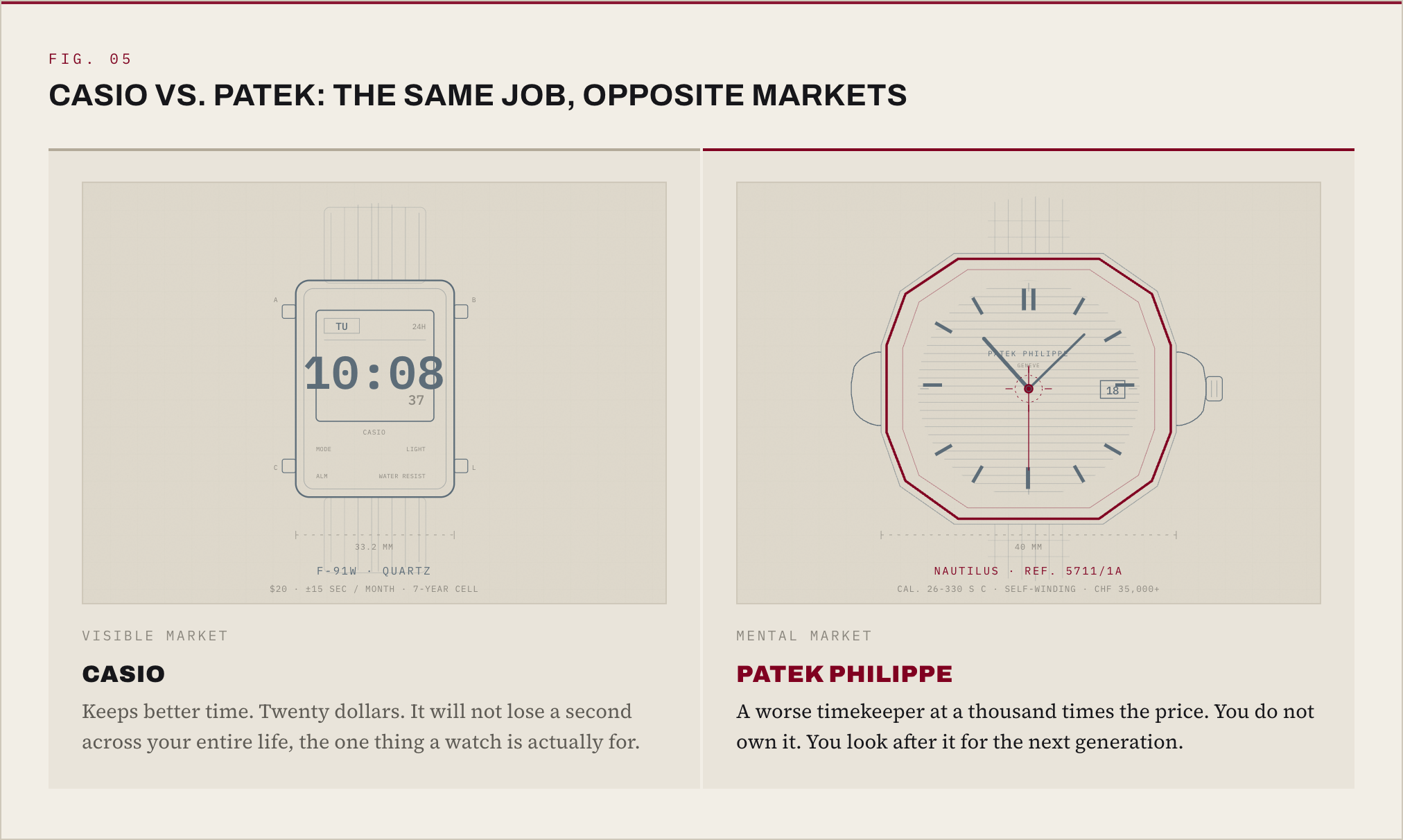
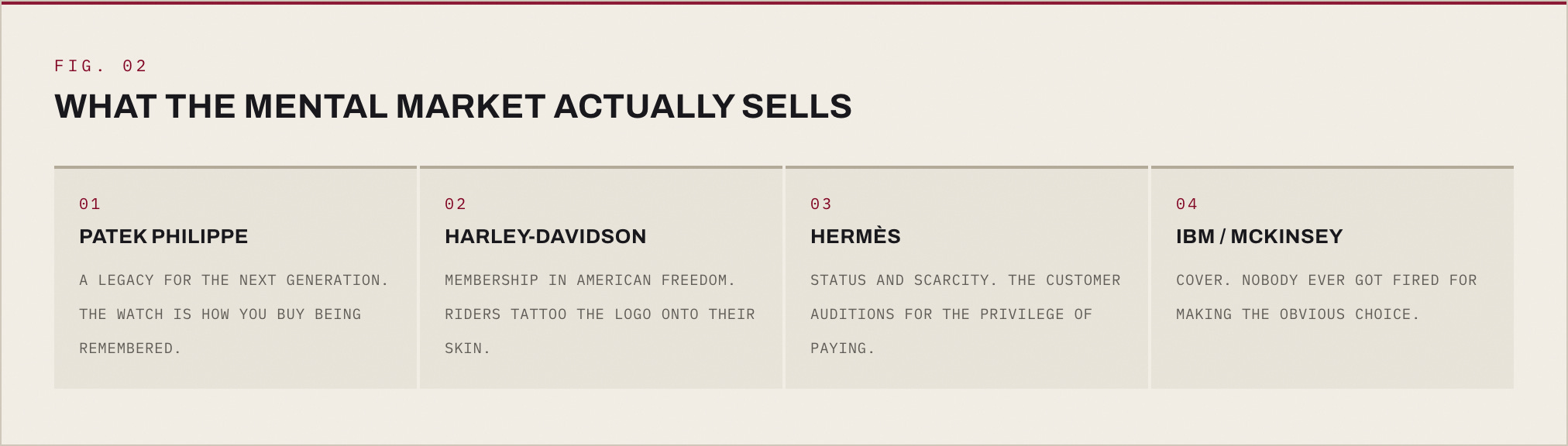
Patek Philippe has spent thirty years telling you that you do not really own their watch. You are simply looking after it for the next generation.
They sell a way to be remembered. A legacy. Status. The time-telling is incidental. That one sentence is why a company making a strictly worse timekeeper commands prices the Casio will never see, in a market the Casio cannot enter.
Of course, this disparity may simply be the result of differing business models. But how do we explain when two competing businesses are very clearly servicing nearly identical market segments, but charging vastly different prices?
Every business competes in two markets at once. Almost every one of them fights in the wrong one.
The Visible Market
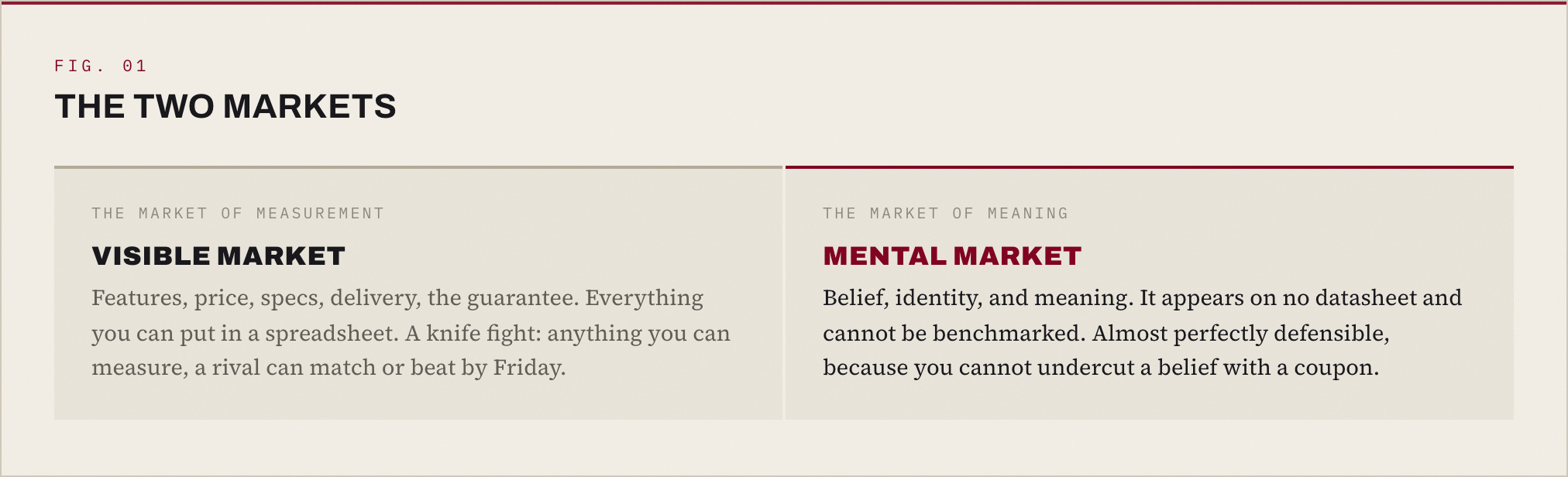
The Visible Market is everything you can measure and drop into a spreadsheet. Features. Product specs. Price. Delivery time. Ingredients. The scope of the guarantee. It is the market of the datasheet and the comparison table, and it is where nearly everyone chooses to compete, for the simple reason that it is the market you can see.
It is also a knife fight with no exit.
Anything you can measure, a competitor can measure too, then match or beat by Friday. You add a feature, they add two. You cut your price, someone cuts deeper. We see this battle prominently between the two leading consumer AI firms; OpenAI & Anthropic, as they release competing features nearly every week at this point. The Visible Market has a floor of zero and a ceiling set by your thinnest-margin rival, and it rewards the patient accumulation of small, copyable advantages that evaporate the moment they start to work. I have watched more good companies exhaust themselves winning arguments in the Visible Market than I have ever seen die of a genuinely bad product. They were commoditized, which is worse than being beaten, because it happens slowly and with everyone's polite agreement.
The Mental Market
Beneath the Visible Market runs a second one, and this is where the money that lasts is made.
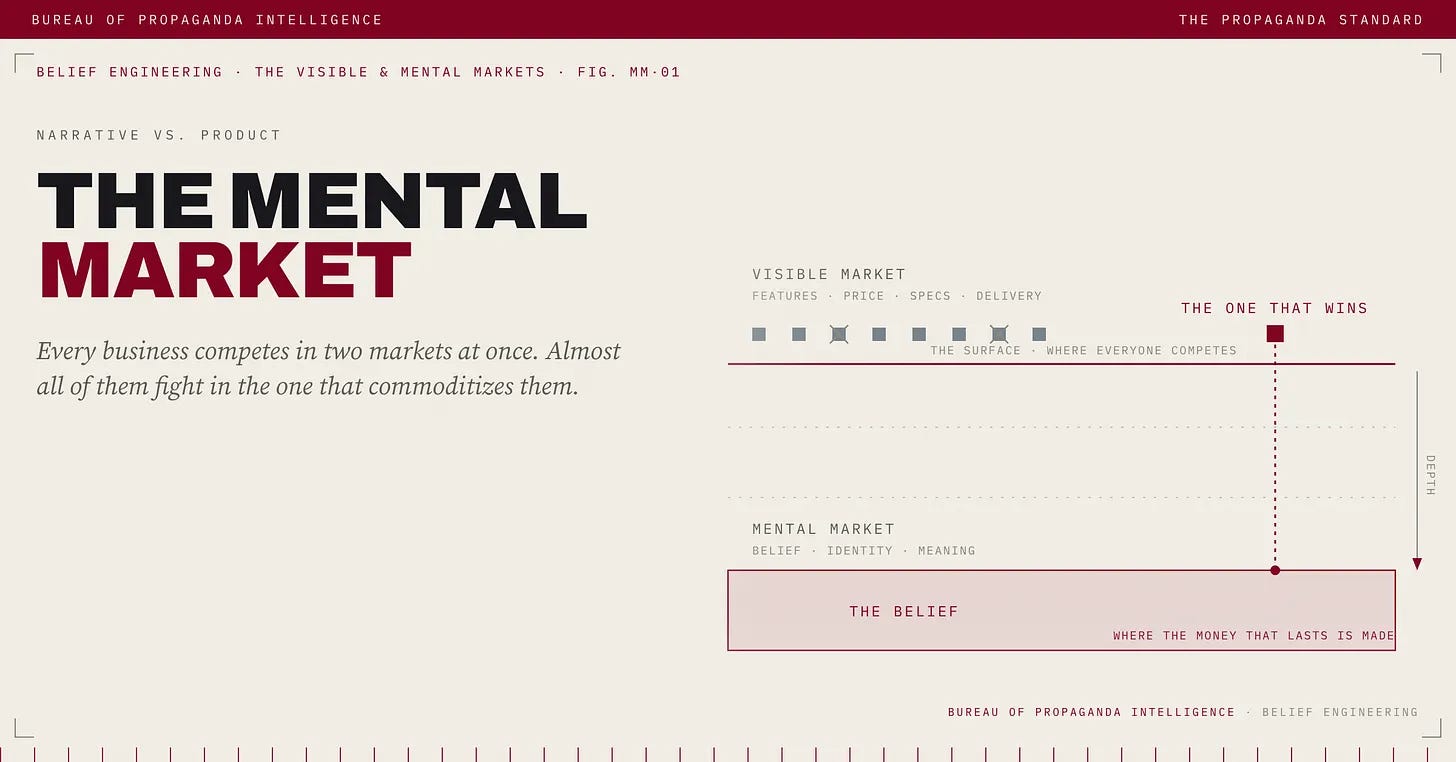
The Mental Market is the market of belief, identity, and meaning. It appears on no datasheet. It cannot be benchmarked. And it is almost perfectly defensible, because you cannot undercut a belief with a coupon.
Three companies operate there in plain sight.
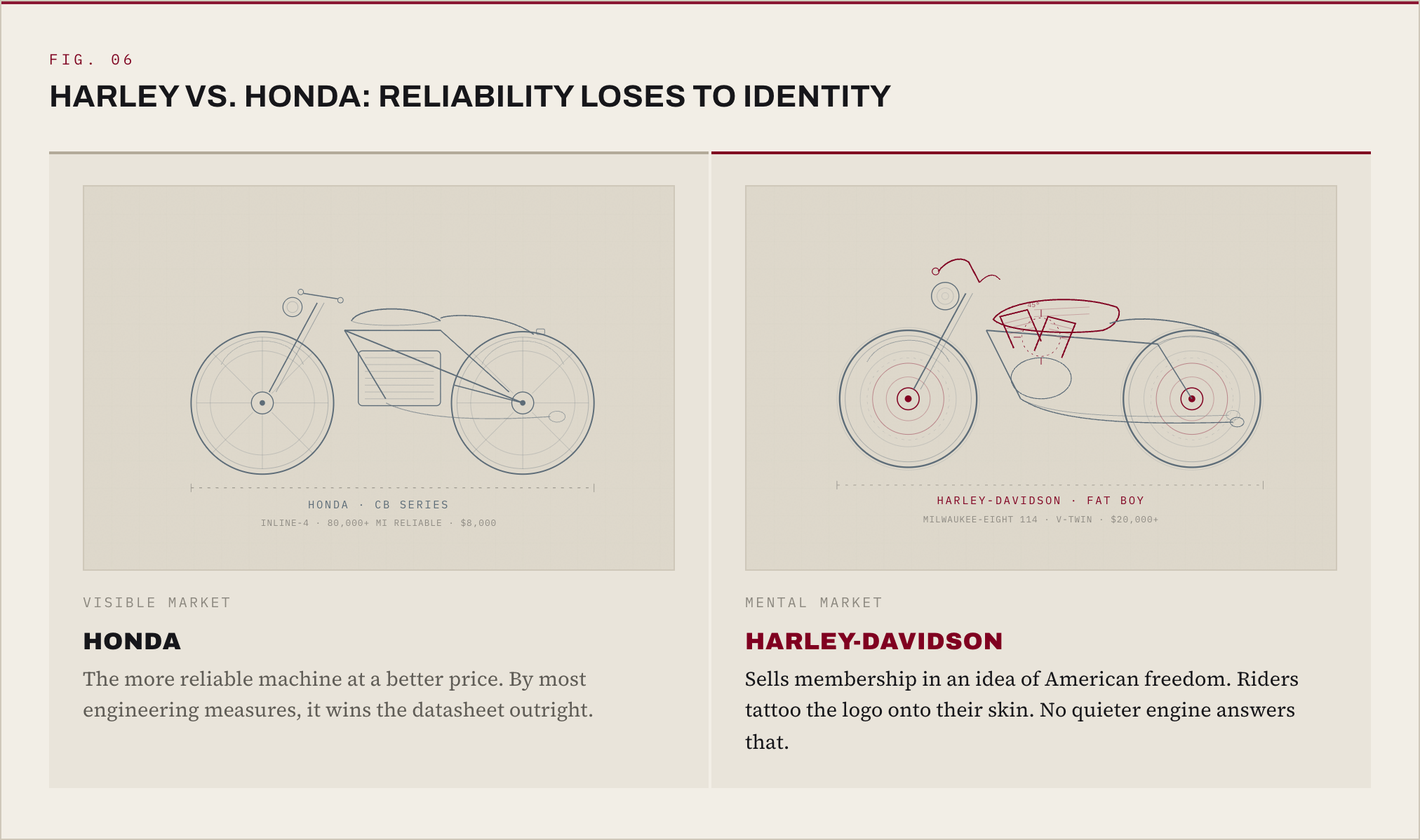
People tattoo the Harley-Davidson bar-and-shield onto their skin. They do not do that with the badge of a Honda, which by most engineering measures builds a more reliable machine at a better price. Harley stopped winning the Visible Market on reliability and value a long time ago, and it did not matter, because Harley never sold transportation. It sold membership in an idea of American freedom that a rider wants stamped on his body. A quieter, cheaper, more dependable engine is no answer to that at all.
Hermès has built something stranger still. By widespread account, you do not walk in and buy their most coveted handbag. You build a history with the house, spend across its other lines, and are eventually permitted to purchase the thing you came for in the first place. They have inverted the entire logic of retail. The customer auditions for the privilege of paying. No feature accomplishes that. Only a belief about status and scarcity, tended carefully for a century, accomplishes that.
And for the executives who would never tattoo anything: for sixty years the safest sentence in corporate technology was "nobody ever got fired for buying IBM." Later it became nobody ever got fired for hiring McKinsey. Neither line has anything to do with the quality of the mainframe or the slide deck. Both describe a belief a nervous buyer is purchasing, that no one can blame him for making the obvious choice. IBM and McKinsey sold cover. That belief has outlived several generations of superior competitors who sold only the better product.
There is no such thing as a "product"
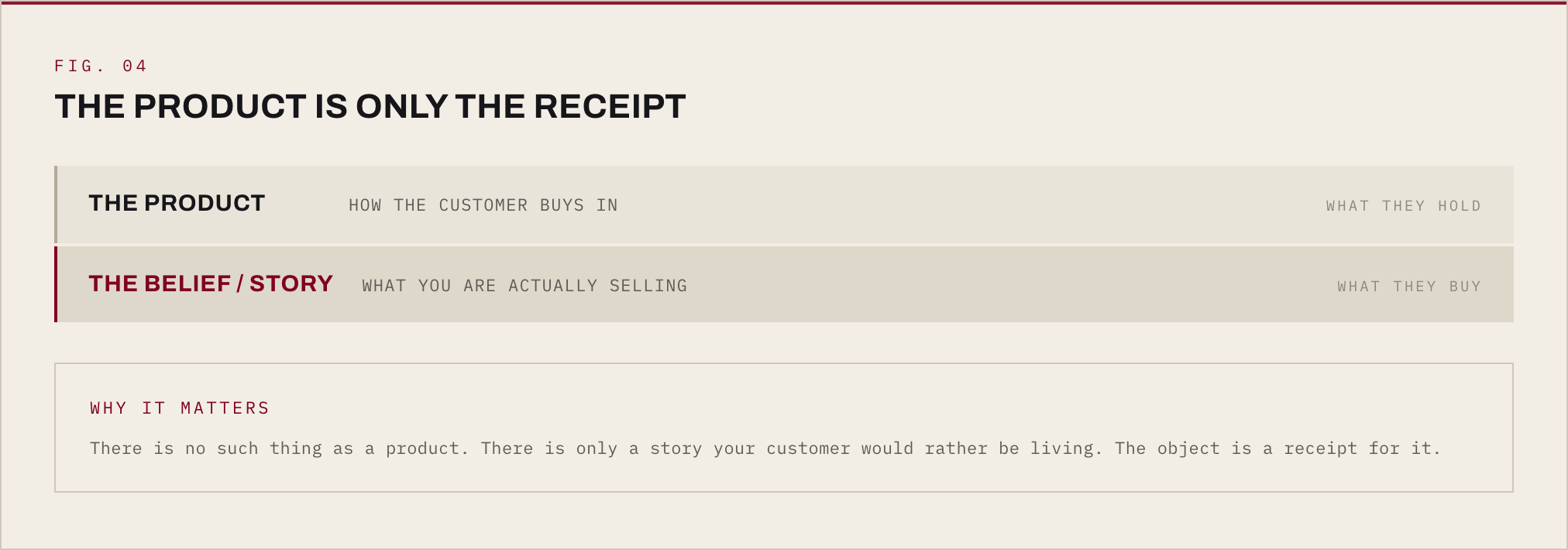
Contrary to popular belief, there is no such thing as a product. There is only a story that your customer would prefer to be experiencing compared to the one they are now.
It's difficult to accept, but once you do it's much easier to transition your business, marketing, and positioning into the more lucrative Mental Market.
In the Mental Market, the product is how the customer buys into the story. You are selling the story itself. The watch is how they buy the legacy. The bag is how they buy the status. The mainframe is how they buy the career protection. The object is a receipt for an idea, a story, or a belief.
Which is why arguing your features to a Mental Market buyer is a category error. You are answering a question they never asked. They did not come to compare specifications. They came to become someone, or to be seen as someone, or to feel something a spreadsheet cannot give them. Meet that with a datasheet and you have told them, precisely, that you do not understand what they wanted.
How You Change Markets
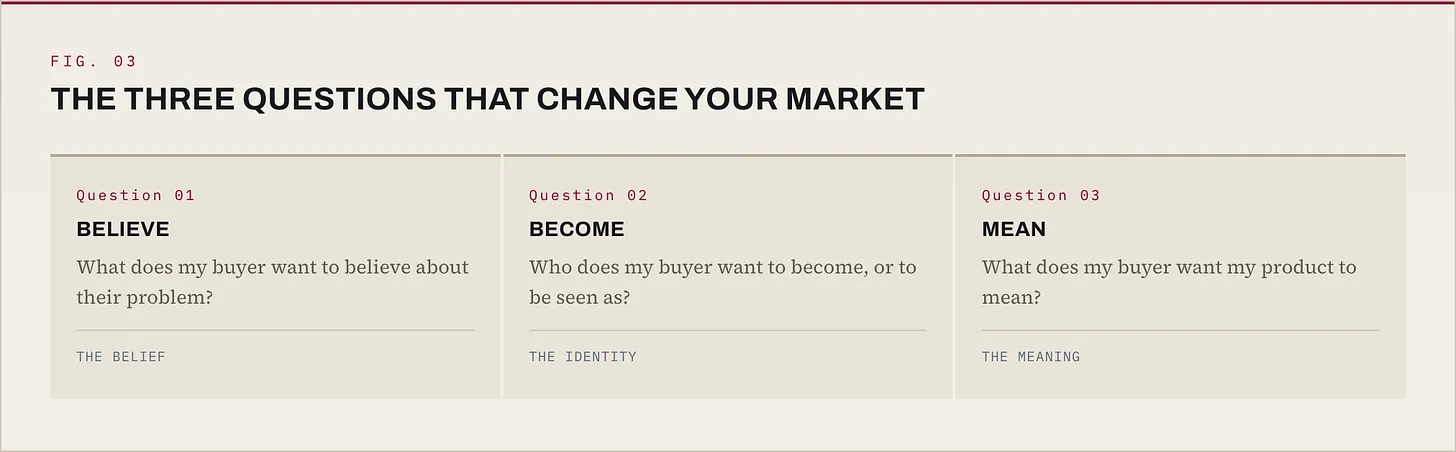
A better product keeps you in the Visible Market. The exit is somewhere else entirely, and it opens the moment you can answer three questions the datasheet cannot.
What does my buyer want to believe? What does my buyer want to become? What does my buyer want my product to mean?
Answer those, build everything you make and say around the answers, and the whole fight changes shape. Price stops being the conversation. Comparison stops being the threat and actually becomes an asset. You are no longer one more entry on a list of measurable things, because you have stopped selling a measurable thing.
This is the terrain my own work lives on. Deep Positioning is how you take ground in the Mental Market. Mass Narrative Engineering is how you manufacture the belief that makes the ground worth holding. Both begin from the same refusal: to compete on what can be measured, in a market that punishes everyone who does.
The Hardest Version of This
There is a class of company for whom the Mental Market is the whole war.
A company building something the world does not yet believe is possible has no Visible Market to fight in. The product barely exists to the buyer or investor, and the specifications describe a thing they are not sure is real. When SpaceX set out to make humanity multiplanetary, no feature comparison was available to run. There was only a belief to install: that this future was going to happen, that it was already inevitable, and that this was the company bringing it. The rockets came second. The belief came first, and the belief is what raised the capital, drew the talent, and bent a decade of expectation into shape around it.
That is the purest form of this work, and it is where I spend most of mine. The companies that will define the next hundred years are rarely the ones holding the best technology in the lab. They are the ones who made the world believe their future was already on its way, and cast themselves as the ones carrying it. The Visible Market cannot even see them yet. They are winning the only market that exists for them, the one in the mind, long before the product is ready to be judged.
The best product rarely wins. The best-installed belief wins, and it goes on winning long after the product that carried it has been passed on every line of the datasheet.
Choose your market accordingly.
Godspeed,
Jared T. Ross
Chief Propaganda Officer
Bureau of Propaganda Intelligence