
There’s no shortage of theories attempting to explain why no human has stepped foot on the moon over the last 50 years.
What you’ll find looking at all of the most plausible (and even the outlandish) explanations from first principles, is an answer that’s a bit disappointing, and shockingly straightforward. In order to understand that answer, we must first understand the misconstrued nature and power of public narrative and propaganda.
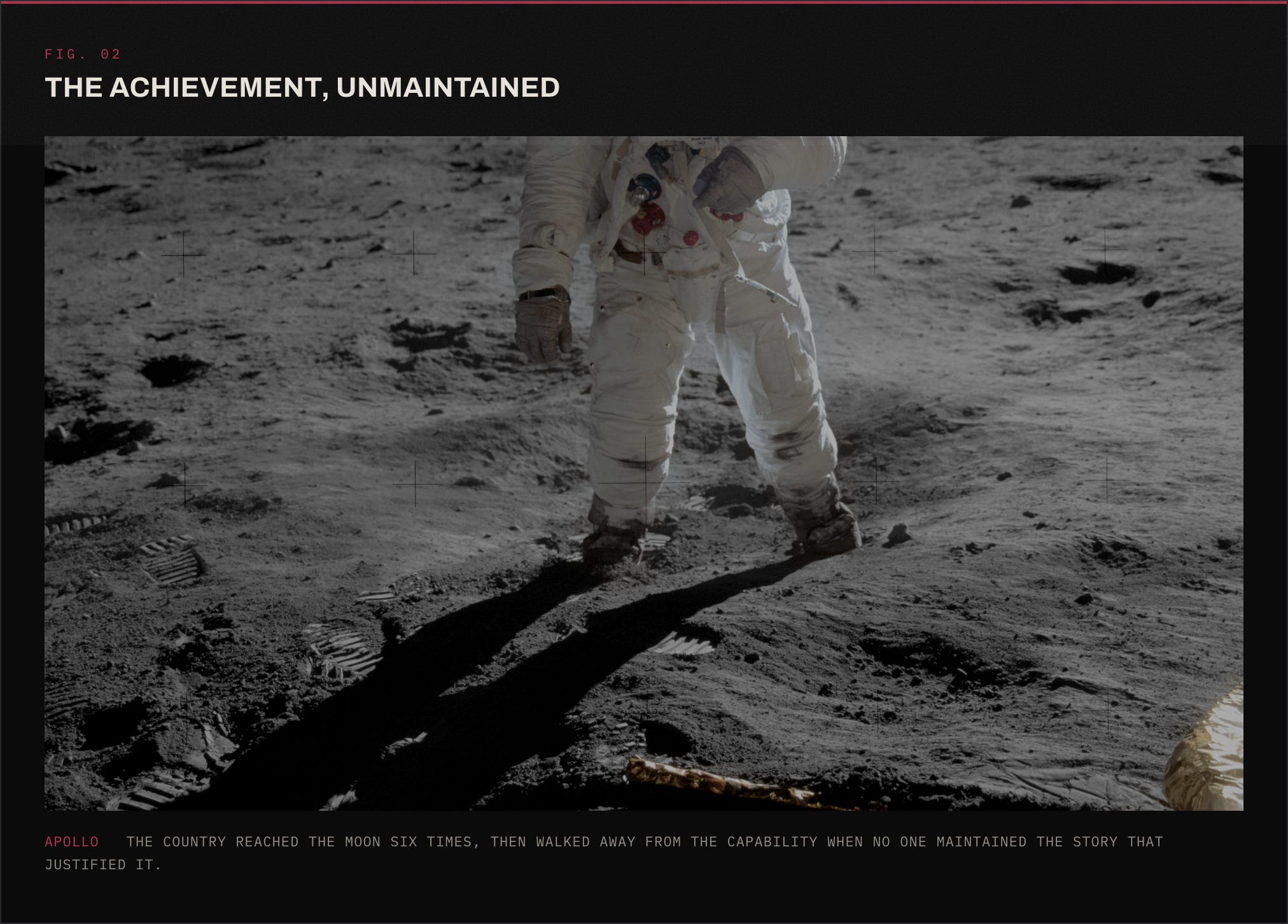
In July 1969, the United States landed two astronauts on the surface of the moon. By December 1972, the program was over. Six missions, twelve human beings on the lunar surface, and then nothing. The science was sound. The engineering worked. The world simply stopped believing it mattered.

The Apollo program ran on a publicly held conviction fueled by Cold War pressure, a presidential mandate, and the visible spectacle of the space race. This combination of circumstances installed a shared belief that reaching the moon was a national imperative. NASA’s budget peaked at 4.4 percent of federal spending in 1966, and by 1975 it had fallen below 1 percent. The workforce contracted, the production lines went quiet, and a country that had put human beings on another world walked away from the capability because no one was maintaining the story that justified it. Once the space race was won, the narrative lost its energy, and the funding, public interest, and political commitment followed it into decay.
The word we now use for an ambitious undertaking is “moonshot,” as though landing on the moon were still hypothetical rather than something we’ve already done. The abandoned Apollo program, and broader lack of fervor for space travel around the world, demonstrates the unfortunate reality that, left alone, even our greatest achievements drift back into the realm of impossible. I call this phenomenon narrative entropy, and the essay that follows details its structure, dangers, and possible solutions.
The Second Law of Narrative Engineering
I borrow the second law of thermodynamics as an analogy, not a claim to physical law. The second law explains that an isolated system — one with no energy entering it — moves naturally toward maximum disorder. An unmaintained narrative behaves the same way, because a narrative left alone is a isolated system: nothing is entering it to hold its order in place. In commerce, a narrative is an artificial ordering of public attention: a company takes chaotic perception, arranges it around a single thesis, and holds it against the constant pressure of competing claims, information decay, and adversarial reframing. The work of maintenance is the energy that keeps the system open. The moment the company stops supplying it, the arrangement closes and breaks down — the market forgets what was proved, the press moves to a more recent spectacle, and competitors recast the company’s strengths as liabilities.
This is the second law of narrative engineering: belief requires continuous energy to hold its form, and left alone it reverts to irrelevance.
If this framework is wrong, it would be wrong in a specific way: there would exist an isolated commercial narrative — one with no structural reinforcement, no institutional backing, no network effects, and no third-party advocates — that maintained its belief position through an extended period of founder silence. That is the disconfirming case, and it would end the argument. In every case I have examined, the narrative that survived silence carried at least one structural mechanism — network incentives, embedded standards, institutional endorsements, or customer identity fusion — and the narratives that carried none fell victim to entropy. Without these mechanisms, and without supplied energy, the narrative a company relies on for capital, talent, and favorable regulation will always drift toward entropy. If true, it demands organizations develop a true narrative strategy in order to address this threat of entropy. Most who come to this conclusion will equate that narrative strategy to public relations, marketing, branding, or broader communications strategy. This approach, however, is a counter-productive symptom of the widespread misunderstanding of the true discipline that addresses narrative decay: propaganda.
The Three Modes of Narrative Decay
When a narrative fails, the people who built it tend to use the word failure as a blanket explanation, which is like calling every illness “being sick.” The value of being more precise in our semantics is being better equipped to address or reverse narrative entropy based on its mode of decay.
Forgetting is the simplest mode and the most relentless. Human memory has a half-life: a prospect who believed a company’s thesis in March holds only a faint impression by September, and if nothing reactivates that belief in the intervening months, it dissolves into the background noise of every other claim the prospect encountered. The decay behaves like a curve. The forgetting curve is well documented, and the memory decay marketers track in brand-recall studies follows a similar shape — related patterns rather than a single proven law, but consistent enough across industries and audiences to plan around. Forgetting is the default; it requires no adversary and no market event, only the passage of time and the absence of a renewed signal. This is what happened to Apollo.
Distortion operates differently. A message warps as it travels from its author to the broader market: nuance disappears, context drops out, and a precise thesis about automated supply-chain infrastructure degrades into a generic headline about artificial intelligence. The vocabulary a company designed to carry a specific meaning gets adopted by competitors or customers who use it to mean something vaguer and more digestible. And once the vocabulary loses its edge, the company that coined it becomes indistinguishable from the companies that borrowed it. Distortion is the natural result of a message passing through too many intermediaries without a rigid definition of what the words are supposed to mean. The company that fails to define its vocabulary in a form that resists reinterpretation will watch that vocabulary get absorbed into the market’s existing categories, taking the company’s distinctiveness with it. The nebulous concept of “the metaverse” demonstrates this particular mode of decay perfectly.
Capture is the adversarial mode. A competitor enters the vacuum a company created with its silence and renames the territory. Xerox built the graphical user interface at its Palo Alto Research Center; Apple captured the narrative of intuitive personal computing. The engineers in Palo Alto executed the invention, and Steve Jobs authored the meaning the culture remembered. Capture is what happens when Forgetting and Distortion have already weakened a narrative enough that an adversary can move in and claim the ground. It is the most damaging of the three modes because it transfers a company’s belief position to a competitor. The company falls behind where it started: the market now associates the territory with someone else, and recapturing it costs more than building it originally did.
These three modes are not mutually exclusive. In most real cases, a company’s narrative is being degraded by all three at once. Leadership stops appearing publicly (Forgetting accelerates). The copywriters and sales team simplify the pitch to close faster (Distortion sets in). A funded competitor launches with the same vocabulary and a cleaner story (Capture begins). The result is a compounding failure that looks, from the inside, like the market “just moved on.” The reality is more nuanced than that. The market did what markets do in the absence of maintained order: it reverted to noise, and someone else supplied a new signal.
Measuring Narrative Exposure
The three modes of decay describe the process by which belief moves toward entropy. A practitioner also needs to know where an organization is currently exposed and how severe that exposure has become. These are different questions — one is about mechanism, the other about diagnosis — and conflating them produces the kind of vague prescriptions that sound strategic and accomplish nothing.
The Bureau’s Narrative Entropy Index approximates an organization’s exposure across five axes. One distinction matters before the axes themselves: the Index measures exposure, not collapse. A high exposure score does not mean a narrative has already failed; it means the axes where failure originates are open, unprotected, or actively contested. Exposure and outcome are separate variables. An organization can carry severe exposure for years before a catalyst converts it into loss, which is precisely why exposure is worth measuring while there is still time to mitigate.
Belief Gap is the current-state read at the center of the Index, and it carries the heaviest weight. It measures the distance between what an organization has actually built and what its market believes it has built, across two dimensions. The first is categorical: the frame the market files the organization under, the nomenclature it uses when deciding what kind of thing this is. The second is specific: what the market thinks the organization does, is, or is becoming. All three modes of decay open this gap. Forgetting lets the specific belief fade; Distortion warps it in transit and can slide the organization off its correct shelf onto a commodity one; Capture installs a competitor’s frame in place of the organization’s own. A belief gap can also exist from the first day — an organization that never told its story correctly, or told it to the wrong audience, carries exposure before any decay begins. This is what the three modes, taken alone, miss: narrative entropy includes the failure to achieve order in the first place. The gap is a condition of the market’s belief itself, and no volume of distribution, proof, or outreach closes it if the story the market accepts is the wrong one. The cost is priced quietly and continuously — capital, buyers, and partners all innately price belief, and a market that misunderstands what an organization builds discounts its valuation, its offers, and its access below what a correctly-informed market would have paid.
Frame Distribution measures the breadth of voices actively carrying the organization’s narrative into the market. A story that travels only through channels the organization operates itself — its own site, its own social, the founder’s own feed — has a ceiling set by the organization’s own attention. A story carried by institutional third-party voices scales past that ceiling; a story no one is distributing, where even the founder has gone quiet, is the worst position of all, because silence is the vacuum that makes Capture easy. This axis measures reach breadth, not accuracy — whether the frame in circulation is correct is the Belief Gap’s concern. For startups specifically, the cost often manifests as a tax on the founder: when only the founder distributes the narrative, every additional mile of reach is bought with executive time, and growth stalls at the boundary of one person’s calendar.
Proof Anchoring measures whether the evidence supporting the narrative exists in sufficient volume, sits concentrated at designated anchors rather than scattered across surfaces, and remains current rather than aged past relevance. It is the structural counterforce to Forgetting. A stakeholder builds conviction efficiently when the strongest proof lives at a discoverable anchor — a keystone case study, a proof page, a documentary, a white paper — and rebuilds it from scratch, or abandons the attempt, when the proof is fragmented or stale. Recent evidence restores what time erodes; a testimonial from this quarter tends to outweigh a case study from three years ago because the market’s memory is always decaying underneath it. The cost is conviction friction: the stakeholder who cannot assemble the proof at the moment they need it delays the decision or defaults to a competitor whose proof was anchored and centralized where they could find it.
Adversary Risk measures the existence and intensity of hostile narrative material in circulation — from latent supply, where category-level concerns exist in the environment but have not yet been aimed at the organization, through active contestation, where a dedicated adversary competes directly for the market’s read. This is the exposure axis behind Capture, and it pairs with Frame Distribution: an adversary needs both a vacuum to move into and a supply of hostile material to move with. Latent supply is the leading indicator that matters most, because it can crystallize on any catalyst — a breach, a whistleblower, a regulator’s speech, a competitor’s campaign — and reshape the market’s read of an organization inside a single news cycle (See: Flock vs DeFlock). Even dormant, it imposes a defensive tax: every proactive narrative move has to be checked against the counter-narrative it might wake. The cost is crisis fragility, the standing risk that a story the organization does not control sits one catalyst away from becoming the story everyone repeats.
Stakeholder Reach measures the mismatch between the audiences an organization’s narrative currently reaches and the stakeholder set that actually decides its survival — buyers, capital, regulators, policy makers, talent, media, partners, public support, in whatever subset the business model requires. It operates differently from the axes above because it is a question of presence rather than decay: a narrative that never reached the deciding audience was never there to erode. High visibility among audiences that do not decide the outcome is reach without leverage. The cost is opportunity that never appears as a loss on any statement — every deciding audience the narrative fails to reach is a set of deals, approvals, hires, and partnerships the organization simply never accesses, and the failure compounds silently because no one sees the outcomes they never generated.
The Index resolves these five scores into a single figure and sorts it into three bands: Contained, Elevated, and Critical. Belief Gap carries the heaviest weight because it is the direct read of the market’s absorbed belief against reality — the state of the position itself. The other four are weighted equally, because each measures a distinct condition governing whether that position holds: whether it is distributed widely enough to endure, anchored in proof enough to withstand scrutiny, defended enough to survive contestation, and aimed at the audiences that convert belief into outcomes.
These four are not upstream causes already captured inside the belief gap; they are the forward conditions that determine its durability, and each is independent in what it measures and how an organization acts on it. That independence is a claim about construct and intervention, not about correlation. In practice, the axes do correlate — a wide belief gap almost always travels with thin frame distribution, and latent adversary supply tends to sit alongside weak proof anchoring — but that correlation is an empirical fact about how organizations fail, not a sign the axes are the same variable. The full methodology and scoring model is published openly at thepropagandabureau.com/nei, and the applied diagnostic it produces is the Bureau’s Narrative Exposure Report (NER). The axes interact and the exposure compounds, which is why diagnosis requires a framework that reads all five at once rather than treating any one symptom in isolation.
Isolated and Structural Narratives
The five axes measure where exposure exists. The question that follows is why some companies are more exposed than others — why the same market conditions destroy one company’s belief position while leaving another’s intact. The answer is in how the narrative was built.
An isolated narrative depends entirely on the continuous effort of its author. It lives on advertising spend, founder appearances, daily content production, and retained public relations. It is a generator running on fuel carried in by hand — the moment the operator stops refueling, the system goes dark. Most venture-backed companies run on isolated narratives, and lock themselves into the visible market, because they never look beyond marketing. The company mistakes high spending for building strong conviction.

A structural narrative generates its own maintenance energy. It relies on mechanisms that operate independent of any single organization’s effort. The belief gets embedded in industry standards, the zeitgeist, legal filings, or professional certification requirements (see: Natural Diamond Council). Periodic events, benchmarks, and published proof artifacts force the market to re-examine the thesis on a fixed schedule. Customers adopt the narrative as a component of their own identity, at which point attacking the company’s category feels, to the buyer, like an attack on their own judgment. Network effects ensure that every new participant increases the cost for existing participants to defect. This is where propaganda earns its place in every business who would like to remain relevant over the course of decades.
The distinction between these two types becomes visible under one condition: absence. If the founder, or company itself, were to stop marketing, or even vanish completely, what happens to the narrative? An isolated narrative begins to collapse within weeks. A structural narrative can persist for years. The fate of your narrative depends on understanding the difference between marketing and propaganda.
Marketing is the organized effort to sell a product or service. It’s tied to a specific company.
Propaganda is the organized effort to sell an idea, narrative, or belief system. It can stand completely separate from any specific company, yet still supports the originator’s objectives.
Consider Bitcoin. Satoshi Nakamoto published the whitepaper in 2008, mined the genesis block in 2009, and disappeared from public communication by 2011. There is no corporate marketing department, no retained public relations firm, and no executive team managing message discipline, and the narrative of immutable digital scarcity compounds annually regardless. The network converts every holder into a participant whose financial interest depends on the thesis holding — the cost of defection is denominated in their own net worth. The founder vanished, and the narrative persisted.
Bitcoin is an extreme case, and treating it as a template would be a mistake. Most companies cannot replicate a network where every participant has a direct financial incentive to defend the narrative. The principle it demonstrates is transferable regardless: the closer a narrative moves from isolated to structural, the less it depends on any single organization’s continued effort to survive.
The Space Race is the case that proves the distinction’s edge. It looked structural — national, multi-institutional, embedded in the zeitgeist, dependent on no single company. But it ran on one exogenous source of energy: the strategic prize of reaching the moon first. That made it an isolated narrative that looked strikingly similar to a structural one, and the timeline is the tell. The narrative collapsed by 1972 even as the Cold War itself ran another two decades, because the energy dissipated the moment the objective was won. A structural narrative has no finish line; its participant economy renews the belief indefinitely unless acted upon. The Space Race had a finish line, crossed it in 1969, and had nothing underneath to keep the belief alive.
The Economics of Narrative Maintenance
The cost of maintaining a belief position varies widely, and the companies that treat narrative strategy as a fixed budget line are consistently surprised by the result.
Igniting a narrative thesis from ground zero is the often most expensive phase. The company must overcome the full weight of existing market assumptions — every prospect already believes something about the category, and displacing that belief requires paying for attention one mind at a time. Although there are occasionally windows of opportunity that allow organizations to take advantage of an existing narrative gaining momentum in their marketplace to cheaply and rapidly catalyze narrative adoption (see: Edward Bernays’ Torches of Freedom campaign). This is the phase where most category-creation efforts fail. The cost of overcoming prior belief runs higher than the founders budgeted for, the board’s patience runs shorter than the adoption curve, and the temptation to retreat into an existing category with established demand is constant. The companies that survive this phase do so by treating the cost as an investment in a position they intend to hold for years, rather than a marketing expense measured against quarterly pipeline.

Once enough people believe the thesis — the point where social proof begins carrying the message without the organization’s direct spending — the cost curve inverts. New prospects encounter the thesis from peers, from press, from third-party analysis, and from the visible behavior of other companies that already adopted it. The company’s capital shifts from ignition to maintenance, and the ratio of spend to belief gained improves dramatically. This is the most profitable ground a company will ever occupy, and the companies that arrive here are often so relieved that they mistake the reduced cost for permission to stop spending entirely. That mistake is how structural advantage gets surrendered: the social proof that carries the message still requires fresh proof to sustain it, and the moment the company stops generating new evidence, the forgetting curve begins to reassert itself.
At the frontier of total category dominance, the curve steepens again. The remaining skeptics are the hardest to move — they have either examined the thesis and rejected it, or they hold an adversarial interest in the thesis being wrong. The cost of converting these holdouts is disproportionate to the value they represent. The correct response is to stop pursuing them. Instead, these holdouts offer a value to your organization that is as powerful as it is rare: an ideological enemy for your already-converted audience to rally against. This is not to suggest targeting and demonizing a group of people, but rather target the narrative they have chosen to adopt instead. Apple did this through their Mac vs PC campaign where they framed PC users as boring and old-hat compared to Macs. Liquid Death runs a similar play, setting their rebellious culture of hydration against the bland corporate beverage establishment. This strategy carries great risk when executed with poor taste or steeped with political ideology. Successfully establishing an effective narrative nemesis requires careful study of the existing narrative landscape, suppressed cultural desires (often sexual in nature), and gumption.
Mitigating Narrative Exposure & Building Structure
Thus far, I’ve alluded to a few strategies that can effectively reduce your narrative exposure to entropy. Given the wide range of possible scenarios an organization may be facing, it would be impractical to propose here all available propaganda strategies in which to mitigate narrative exposure. The nuance required for effective narrative management is precisely why every organization ought to establish a dedicated role for propaganda and narrative engineering. I’ve previously detailed why that role is fundamentally different from marketing, PR, and branding here.
Nonetheless, it is my intention to focus my writing on being highly practical for readers so I will offer a concrete propaganda strategy that is broadly applicable for most well-funded organizations looking to minimize narrative exposure.
Individual companies build structural narratives through repositioning, proof distribution, vocabulary control, and audience targeting. These are the intermediate moves, and for most companies they are the correct first investment. The highest form of structural narrative — the form that survives the founder, the board, the market cycle, and the competitive generation that follows — is the narrative institution.
A narrative institution is an entity that publishes the standard of record, establishes the indices that score an industry, and defines the vocabulary that participants must adopt to remain intelligible. These are also commonly called trade associations, consortiums, lobbying groups, coalitions, and more. When an institution controls the standard, it ceases to compete for attention; the market complies with the reality the institution constructed, because operating outside the shared language means operating outside the market’s comprehension. Three cases illustrate how this works in practice and why no individual company could have achieved the same result alone.

In 2015, seven of the world’s largest diamond mining companies — De Beers, Alrosa, Rio Tinto, and four others — formed the Diamond Producers Association (DPA) with a single strategic objective: hold the narrative of natural diamond value against the emerging lab-grown market. De Beers had run “A Diamond Is Forever” for decades with great success. But with lab-grown diamonds offering an identical product at a fraction of the price, narrative exposure for all natural diamond producers skyrocketed. The DPA, renamed the Natural Diamond Council in 2020, moved the narrative from a single company’s marketing budget to an institutional platform. The Council publishes the standard for what constitutes a “natural” diamond, funds provenance verification research, and controls the vocabulary — “natural” versus “laboratory-grown” — that frames how every consumer evaluates the choice. No single mining company could sustain this narrative alone; the institution distributes both the cost and the authority across an industry, and the belief it maintains belongs to the category rather than to any one producer’s balance sheet.
The American brewing industry traces its institutional lineage to 1862, when the United States Brewers’ Association was formed during the Civil War — one of the oldest trade organizations in American commercial history. The modern Beer Institute, established in 1986 as the USBA’s successor, represents the major brewers and importers. What makes this case instructive is what happened when the industry’s category structure came under pressure. In the 2010s, craft beer challenged the market position of every major brewer in America, and the contest was over who controlled the definition of the category. The Brewers Association, representing small and independent producers, created the “independent craft” seal in 2017, drawing a public line between breweries that were independently owned and breweries that had been acquired by multinational conglomerates. That seal was an act of category engineering; it redrew the category lines. The vocabulary shifted from “craft” versus “macro” to “independent” versus “acquired,” and the institution that authored the new vocabulary determined which companies landed on which side of the divide. This is definitional control executed through institutional infrastructure, and it demonstrates a principle the essay has been building toward: the entity that controls the categories the market thinks in controls the field the market competes on. Companies compete inside categories; institutions define them.
The California Milk Processor Board was created in 1993 to solve a problem no individual dairy company could address on its own: per capita milk consumption in the United States had been declining for two decades. “Got Milk?” became one of the most recognized advertising campaigns in American history, running for more than twenty years and achieving the kind of cultural saturation that individual brands spend billions chasing and almost never reach. The insight behind the campaign was structural before it was creative. The Board was funded by mandatory assessments on every milk processor in California, so no single company’s budget decision could defund the narrative. When Goodby Silverstein & Partners created the first “Got Milk?” spot — a man with a mouthful of peanut butter, reaching for an empty carton — they were illustrating a principle that applies far beyond dairy: people do not appreciate what is always present until it is absent. The campaign outlasted every individual dairy company’s marketing cycle because the institution that funded it outlasted them too. The belief it created — that milk is essential, unremarkable, and irreplaceable — survived the campaign’s eventual conclusion, because by that point the belief was embedded in an entire generation’s default assumptions about nutrition and routine.

These three cases share a structural feature that distinguishes the narrative institution from most other forms of narrative reinforcement. An individual company’s structural narrative — even a strong one — is still tethered to the company’s continued existence and strategic consistency. An institution outlasts the individual participants. De Beers could exit the Natural Diamond Council tomorrow, and the Council would continue to define what “natural” means. Any single craft brewery could close, and the Brewers Association’s “independent” seal would still govern the category. The California Milk Processor Board’s mandatory funding structure meant that no single processor’s budget decision could defund the narrative. This is what makes the institution the highest form: it is the narrative structure that survives the departure of any individual contributor, including the one who built it.
The Answer We Started With
No one has walked on the moon in over fifty years, and the usual explanations of the cost, the risk, the absence of a rationale once the race was won are real but downstream. Each is a symptom of the same root: the belief that it mattered was never given a structure that could renew itself once the objective was claimed. The capability was never the constraint. The blueprints survive, the physics has not changed, and a dozen nations and companies could rebuild the hardware inside a decade if the will were there (excitingly, that will has returned in recent years). The Space Race looked like the most durable narrative in the world — national, total, impossible to miss — and it ran on a single momentary prize: reaching the moon first. The prize, along with a few victory laps, was claimed in 1969, and no institution had been built to carry the belief past it. Apollo proved a civilization can reach the moon. It also proved that reaching a thing and keeping it are different achievements, governed by different laws.

This is the uncomfortable center of the discipline. Ingenuity is abundant and belief is scarce, and the distance between what humanity can do and what it currently believes is worth doing is set almost entirely by which narratives are being actively maintained and which have been left to decay. Every achievement a civilization holds onto — the meaning of a diamond, the worth of a vaccine, the ambition to leave the planet — it persists because someone, somewhere, is still spending the time and money to keep the belief in place.
Marketing aims to sell a product. Propaganda maintains a belief until that belief becomes the water the market forgets it is swimming in. The organizations that intend to matter across decades, and the civilizations that intend to keep what they build, are the ones that stop treating narrative as a campaign to be run and start treating it as a structure to be engineered, staffed, and defended without end.
Godspeed.
Jared T. Ross
Chief Propaganda Officer
Bureau of Propaganda Intelligence